
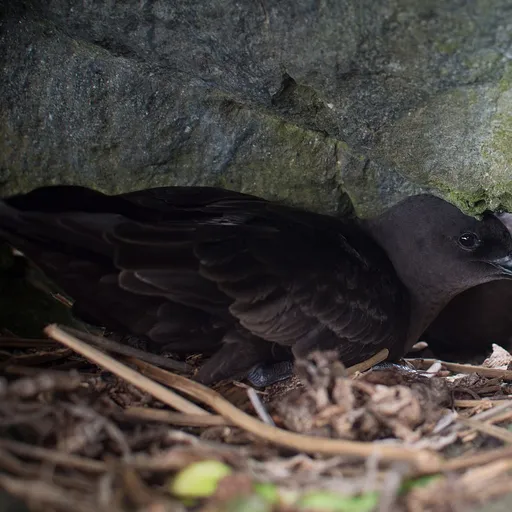
Bulwer's Petrel
Bulweria bulwerii
Least Concern
Overview
Bulwer's petrel (Bulweria bulwerii) is a small petrel in the family Procellariidae found in tropical and subtropical regions of the Atlantic, Indian and Pacific Oceans. It is a highly pelagic marine bird that is usually far from land, except during the breeding season. The species is named after the English naturalist James Bulwer.
Identification
- 25–29 cm in length with a 78–90 cm wingspan
- Mainly brown plumage with a long pointed tail
- Very long-winged with a buoyant twisting flight
Habitat
This species has a wide distribution through tropical and subtropical regions of the Atlantic, Indian and Pacific Oceans. It is a year-round resident in several locations, including Cabo Verde, China, French Guiana, Indonesia, Japan, Malaysia, Mauritania, Morocco, Saint Helena, Ascension and Tristan da Cunha, Senegal and Taiwan. Breeding occurs in the Macaronesian Islands and continental Portugal in the Atlantic, and from eastern China and the Bonin Islands east to the Hawaiian Islands, Marquesas Islands, United States Minor Outlying Islands and Kiribati in the Pacific.
Diet
Bulwer's petrel is highly pelagic and rarely found near land except during the breeding season. Its diet mainly consists of small fish, such as sardines, and squid, with some additional crustaceans like crabs, krill and shrimp, and plankton. It picks planktonic food items from the ocean surface.
Did you know?
When breeding, Bulwer's petrels will always return to their previous nest site and mate with their previous mate. Nests are built in burrows, vegetation, cliff caves or crevices, and under man-made debris or onshore driftwood, but the birds do not excavate these burrows.
Sources
- Wikipedia · CC BY-SA 4.0
- Wikidata · CC0 1.0