
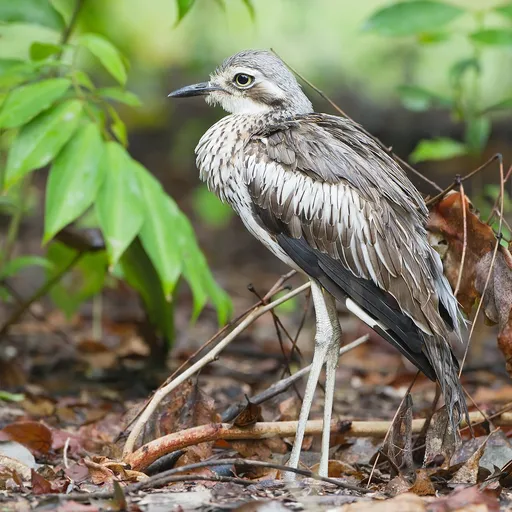
Bush Stone-curlew
Burhinus grallarius
Least Concern
Overview
The bush stone-curlew, also known as the bush thick-knee, is a large, ground-dwelling bird endemic to Australia. It is a member of the family Burhinidae and is primarily nocturnal, relying on cryptic plumage to evade predators during the day.
Identification
- A large, slender bird approximately 550 mm in length with a wingspan approaching 1 m.
- Grey-brown plumage with conspicuous dark streaks on the upperparts and lower sides, and a light buff patch visible on the black flight feathers when extended.
- Features large, bright yellow irises with black bare skin nearby, a darkish bill, and long olive-green legs.
- Distinctive head markings include a dark band over the eye and down the neck, contrasting with a buff forehead.
Habitat
Favours open plains, eucalyptus woodland, grassy plains, and arid scrubland, but is rarely seen in rainforest, arid desert, or urban areas. The species is found throughout the Australian mainland apart from the Western Australian coast and Tasmania, as well as on nearby offshore islands and a small breeding population in southern New Guinea.
Diet
Specialises in hunting small animals such as insects, frogs, spiders, molluscs, crustaceans, snakes, lizards, and small mammals, which are mostly gleaned or probed from soft soil or rotting wood. A few seeds or tubers are also consumed, particularly during drought years.
Did you know?
The species is so cryptic that when disturbed by an observer, it may adopt a rigid, motionless posture that it maintains even if the bird is handled.
Sources
- Wikipedia · CC BY-SA 4.0
- Wikidata · CC0 1.0