
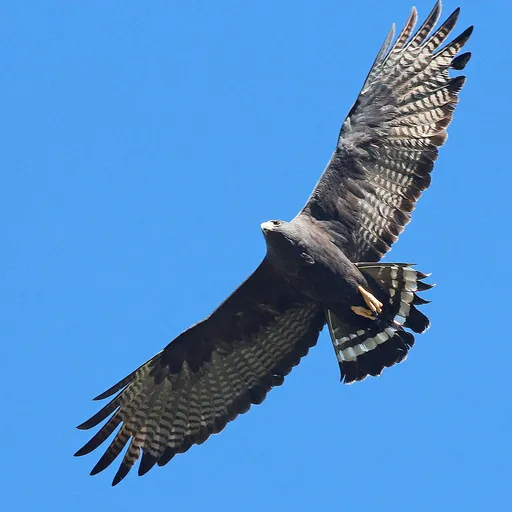
Zone-tailed Hawk
Buteo albonotatus
Least Concern
Overview
The zone-tailed hawk (Buteo albonotatus) is a medium-sized hawk of warm, dry parts of the Americas that is somewhat similar in plumage and flight style to the turkey vulture. It is classified as Least Concern on the IUCN Red List and is monotypic, meaning no subspecies are recognised.
Identification
- Adults have mostly blackish plumage with flight feathers barred in lighter gray that appear solid silver-gray from a distance.
- The tail features three or four white bands from below and light gray from above, with the second band from the tip being particularly broad and conspicuous.
- Birds are medium to large but slender, measuring 46–56 cm in length with a wingspan of 117–140 cm, and possess yellow cere and legs.
- The call is a loud scream that drops in pitch at the end, often described as 'kra kree-kree-kree-kree', sometimes with an abrupt rise to a falsetto pitch in the middle.
Habitat
The species ranges from southern North America through inland Mexico and Central America down into parts of South America, including eastern Colombia, Ecuador, and sporadically into Peru, Brazil, Paraguay, Bolivia, and northern Argentina. They adapt to various habitats, from coniferous or pine-oak forests to dry open scrub and humid marshes, but always require scattered tree thickets for nesting. While found from sea level to 3,000 m, they are mainly located below 1,500 m in the north and 500 m in the southern reaches of their breeding range.
Diet
This hawk mainly preys on small birds, mammals, and reptiles, including lizards, rats, mice, and squirrels, as well as nestlings and fledglings. It forages very actively by transects and random quartering in low flight, using cover like trees to approach prey within striking distance without landing. Outside the breeding pair bond, these hawks are wholly solitary and are not known to hunt in pairs.
Did you know?
Some ornithologists believe the zone-tailed hawk's close resemblance to turkey vultures is a form of aggressive mimicry that deceives potential prey into believing the hawk is not a threat. This theory is supported by the observation that zone-tailed hawks have higher hunting success rates when mingling with kettles of turkey vultures compared to when hunting alone.
Sources
- Wikipedia · CC BY-SA 4.0
- Wikidata · CC0 1.0