
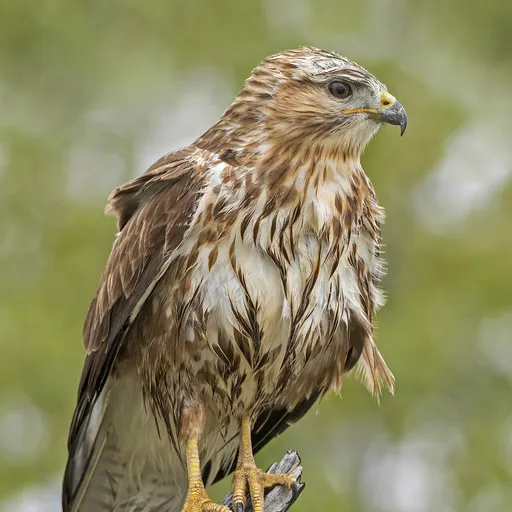
Common Buzzard
Buteo buteo
Least Concern
Listen
XC797481 · Grégoire Chauvot · Arrondissement de Villefranche-sur-Saône (near Cours), Rhône, Auvergne-Rhône-Alpes, France · CC0 1.0
Overview
The common buzzard (Buteo buteo) is a medium-sized bird of prey that appears to be the most common diurnal raptor in Europe, with a global population numbering in the millions. Classified as Least Concern by the IUCN Red List, this species is widely distributed and highly adaptable.
Identification
- A medium-sized raptor measuring 40 to 58 cm in length with a wingspan of 109–140 cm, featuring a distinctly round head, a slender bill, and long wings that reach or fall slightly short of the tail tip.
- Plumage is highly variable, ranging from dark brown to pale whitish, but typically features a brown-streaked white throat, a darker chest, and a tail that is narrowly barred grey-brown and dark brown with a broad dark subterminal band.
- In flight, typical European birds show a dark trailing edge to the wings when viewed from below and a broad dark subterminal tail band from above, while paler individuals may display dark carpal patches resembling blackish arches.
Habitat
The species inhabits most of Europe and extends its breeding range across much of the Palearctic to northwestern China, far western Siberia, and northwestern Mongolia. While a year-round resident over much of its range, populations from colder northern regions and the eastern part of the range typically migrate south for the winter, with some journeying as far as South Africa.
Diet
An opportunistic predator, the common buzzard feeds mostly on small mammals, particularly rodents such as voles, though it can take a wide variety of prey. It typically hunts from a perch.
Did you know?
The common buzzard was the first bird species to be formally described by Carl Linnaeus in 1758, originally classified under the binomial name Falco buteo. DNA testing has revealed that it is fairly closely related to the red-tailed hawk of North America, to the point that the two may belong to the same species complex.
Sources
- Wikipedia · CC BY-SA 4.0
- Wikidata · CC0 1.0