
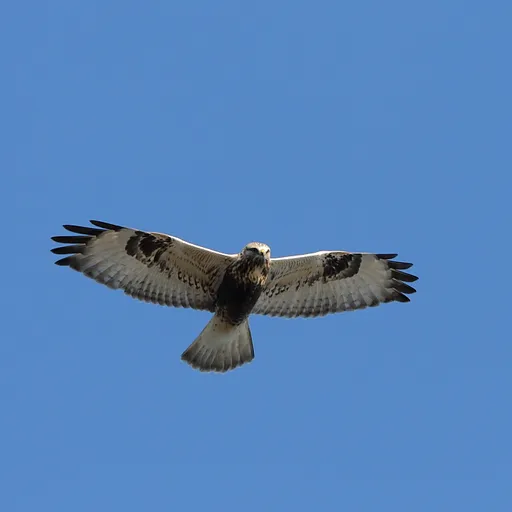
Rough-legged Buzzard
Buteo lagopus
Least Concern
Overview
The rough-legged buzzard (Buteo lagopus), known as the rough-legged hawk in North America, is a medium-large raptor with a complete circumpolar distribution across the northern continents. It breeds in arctic and subarctic regions during the summer but migrates south to temperate areas for the winter.
Identification
- Predominantly brown and white plumage with extensive speckling, often featuring a broad brown chest-band and a square dark carpal patch that contrasts with white under-wings in light morphs.
- Distinguished by long white tail feathers with one or more dark subterminal bands and wing tips that reach or extend past the tail when perched.
- Legs are feathered down to the toes (excluding the toes themselves) as an adaptation to cold, a trait reflected in its scientific name lagopus, meaning 'hare-foot'.
- Appears slightly larger and more eagle-like than the common buzzard, with longer wings.
Habitat
Breeds in tundra and taiga habitats across North America and Eurasia, with nests typically located on cliffs, bluffs, or in trees within areas of open ground. During winter months, it inhabits marshes, moorland, prairies, and agricultural regions where rodent prey is most abundant. It is the only member of its genus found in all three northern continents, maintaining a complete circumpolar range.
Diet
Carnivorous species that primarily feeds on small mammals, with lemmings and voles constituting up to 90% of its diet. It also consumes birds, particularly passerines and ptarmigans, and will prey on larger mammals such as hares and prairie dogs when rodents are scarce. Hunting is opportunistic and often involves hovering over one spot to scan for prey, a behaviour rarely seen in raptors of this size.
Did you know?
This species possesses the unusual ability to see vole scent marks that are visible only in the ultraviolet range, allowing it to locate prey based on scent trails rather than just visual cues.
Sources
- Wikipedia · CC BY-SA 4.0
- Wikidata · CC0 1.0