
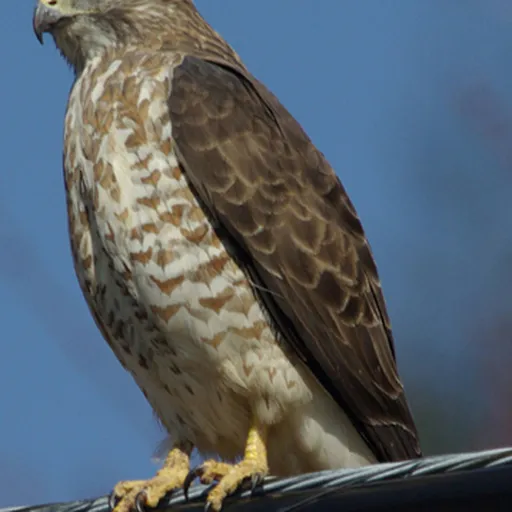
Broad-winged Hawk
Buteo platypterus
Least Concern
Listen
XC1076781 · Rosa Elena Albornoz @rosaelena_naturaleza · Bosque Amnesia del Poder (near Caracas), Sucre, Miranda, Venezuela · CC0 1.0
Overview
The Buteo platypterus, or broad-winged hawk, is a medium-sized raptor found across North and South America, though it is not currently listed as an endangered species. During the summer, some subspecies breed in eastern North America before migrating south to the Neotropics in the winter, while others remain as permanent residents on Caribbean islands. Females are slightly larger than males, and the population is generally increasing despite local declines caused by forest fragmentation.
Identification
- Relatively short and broad wings with a unique tapered, pointed appearance, and a short tail.
- Two primary color morphs exist: a dark morph with less white and a light morph that is more pale overall.
- Adults feature a dark brown body with a white belly and chest, marked with horizontal barring, while juveniles have more white and longitudinal barring.
- A high-pitched call that sounds like a whistle, described as a 'kee-ee', is used for communication and territorial displays.
Habitat
Breeding occurs in the northern and eastern parts of North America in deciduous forests, while migrating subspecies overwinter in deciduous and mixed forests in the Neotropics, from Mexico to southern Brazil. Five subspecies are permanent residents on Caribbean islands. Although they breed in forests, they forage in wetlands and meadows and avoid human settlements even when living near them.
Diet
Broad-winged hawks are carnivores that feed on a variety of insects, amphibians, reptiles, small mammals such as mice and rabbits, and birds like quail and grouse. They forage by watching from low branches and hiding in foliage before performing a short, fast glide to capture prey. They spend significant time preparing their food, such as skinning frogs and snakes, though small mammals are often consumed whole.
Did you know?
Migrating flocks of several thousand hawks are known as 'kettles', which form a spectacular migration scene at locations such as Hawk Mountain in Pennsylvania and the River of Raptors in Veracruz. These birds can travel over 6,000 km from North America to South America without crossing salt water, relying on thermals to soar through their journey.
Sources
- Wikipedia · CC BY-SA 4.0
- Wikidata · CC0 1.0