
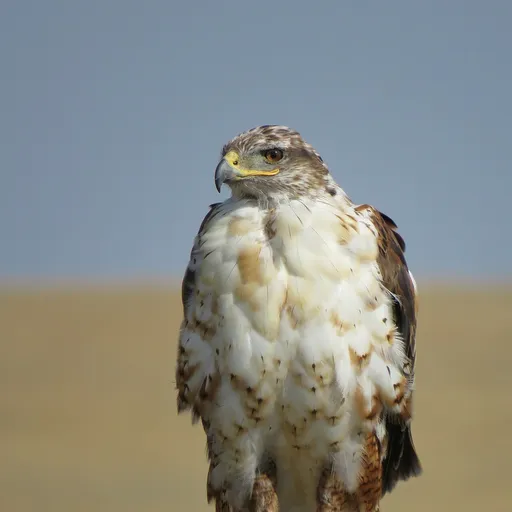
Ferruginous Hawk
Buteo regalis
Least Concern
Overview
The ferruginous hawk (Buteo regalis) is the largest of the North American Buteos and is frequently mistaken for an eagle due to its size and proportions. This broad-winged bird of prey is endemic to the interior parts of North America and is currently listed as Least Concern by the IUCN. It is also used as a falconry bird within its native ranges.
Identification
- Perched birds exhibit a white breast and body with dark, feathered legs that form a distinct 'V' shape on the underside.
- The back and wings are a brownish rust color, with a white head featuring a dark streak extending behind the eye.
- In flight, the bird soars with wings held in a strong dihedral, displaying two light 'windows' on the outer wings and a rufous rump mark.
- The voice is not well-described, but alarm calls consist of kree-a, ke-ah, or harsh kaah notes that resemble the screams of a red-tailed hawk or herring gull.
Habitat
These hawks inhabit arid and semiarid grasslands, open prairies, and bush steppe country, avoiding high elevations, forest interiors, and narrow canyons. During the breeding season, they prefer grasslands, sagebrush, and arid shrub country, while winter habitats may include cultivated areas where standing stubble provides prey. Nesting occurs in open areas or in trees such as cottonwoods, willows, and swamp oaks, with perches like poles, lone trees, and rocky outcrops being a requisite feature.
Diet
The ferruginous hawk primarily hunts small to medium-sized mammals, which constitute 80–90% of its diet, though it also takes birds, reptiles, and insects. Foraging methods include soaring, hovering, low-level flight, and ambushing prey at burrows, with a strike-and-kill predation style involving powerful talons. Prey species vary geographically but often include ground squirrels, pocket gophers, jackrabbits, and hares.
Did you know?
Ferruginous hawks engage in piracy by gathering around hunters shooting prairie dogs to claim and mantle over the shot prey. They are also capable of cooperative hunting, where mates assist each other in capturing large jackrabbits weighing up to 3.63 kg.
Sources
- Wikipedia · CC BY-SA 4.0
- Wikidata · CC0 1.0