
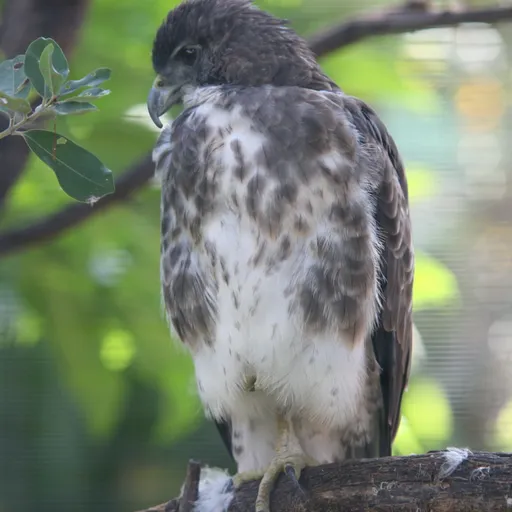
Hawaiian Hawk
Buteo solitarius
Near Threatened
Overview
The Hawaiian hawk, also known as the ʻio, is a raptor in the genus Buteo endemic to Hawaiʻi. Currently restricted to the Big Island, it is one of only two native birds of prey on the islands, alongside the pueo. The species is classified as Near Threatened by the IUCN.
Identification
- Measures 40 to 46 cm in length, with females being larger than males.
- Exhibits two colour phases: a dark phase with a dark brown head, breast, and underwings, or a light phase with a dark head, light breast, and light underwings.
- Adults have yellowish feet and legs, whereas juveniles have greenish legs.
- Produces a shrill, high-pitched call resembling 'eeeh-oh', and is notably noisy during the breeding season.
Habitat
The ʻio is found exclusively in stands of native ʻōhiʻa lehua trees on the Big Island of Hawaiʻi. Although it currently breeds only there, fossil evidence indicates that the species previously inhabited Molokaʻi, Oʻahu, Maui, and Kauaʻi.
Diet
As an opportunistic predator, it preys on introduced animals such as rats, lizards, and game birds, as well as invertebrates and smaller birds. It hunts by remaining in a stationary position or by diving on prey from the air.
Did you know?
The ʻio is a significant threat to the recovery of the Hawaiian crow, which is extinct in the wild, as the hawks prey upon them. In Hawaiian legend, the bird was a royal symbol, and its name 'ʻiolani' means 'exalted hawk'.
Sources
- Wikipedia · CC BY-SA 4.0
- Wikidata · CC0 1.0