
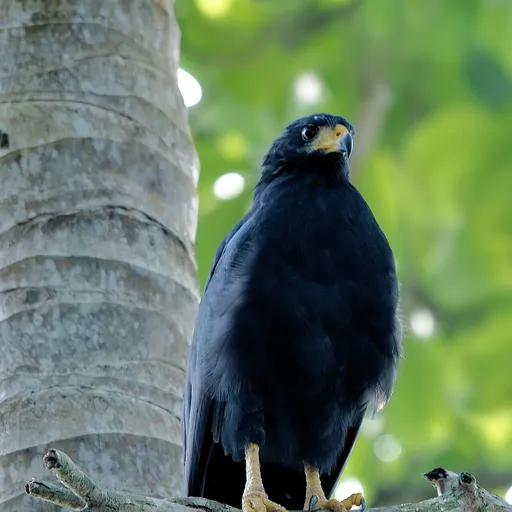
Common Black Hawk
Buteogallus anthracinus
Least Concern
Listen
XC1028420 · Gean Carlo Valdés · Islas secas, Panama · CC0 1.0
Overview
The common black hawk (Buteogallus anthracinus) is a bird of prey in the family Accipitridae. It is a mainly coastal, resident species found across the warmer parts of the Americas, from the Southwestern United States to South America.
Identification
- Adults are 43–53 cm long with very broad wings and are mainly black or dark grey.
- Features a short tail with a single broad white band and white tip, a black bill, and yellow legs and cere.
- Immatures are dark brown above with spotting and streaks, and have buff to whitish underparts with dark blotches.
- The call is a distinctive piping sequence described as 'spink-speenk-speenk-spink-spink-spink'.
Habitat
This species inhabits mangrove swamps, estuaries, and adjacent dry open woodland, though inland populations also exist. Its range covers the warmer parts of the Americas, including the Southwestern United States, Central America, Venezuela, Peru, Trinidad, and the Lesser Antilles.
Diet
The common black hawk feeds mainly on crabs, especially land crabs, and crayfish, but also consumes small vertebrates such as fish, frogs, lizards, snakes, and young or injured birds and mammals. It supplements its diet with carrion, eggs, and various insects including grasshoppers, caterpillars, and wasp larvae.
Did you know?
Natural hybridisation between the common black hawk and the red-shouldered hawk has been documented in Sonoma County, California. This hybridisation between different genera of hawks is considered rare.
Sources
- Wikipedia · CC BY-SA 4.0
- Wikidata · CC0 1.0