
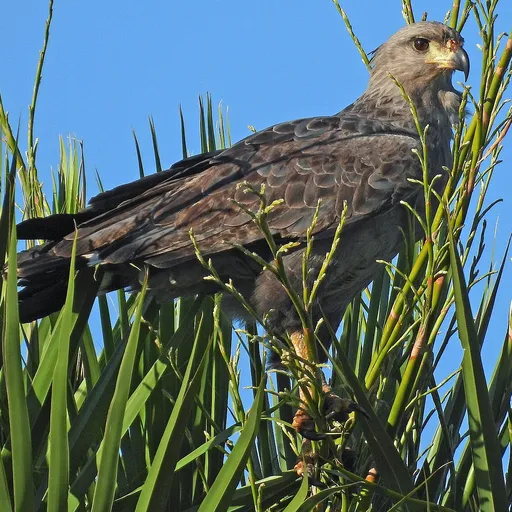
Chaco Eagle
Buteogallus coronatus
Endangered
Overview
The Chaco eagle (Buteogallus coronatus), also known as the crowned solitary eagle, is an endangered large raptor endemic to eastern and central South America. It is one of the largest raptors in the Neotropics, though it is one of the rarest and most threatened due to habitat loss and human persecution.
Identification
- Plumage: Mostly dull and silvery grey body with a crest of darker grey feathers; juveniles are dark brown with a creamy head and underbody streaked with grey.
- Tail: Short black tail featuring a broad white medial band and a white tip.
- Structure: Yellow cere and legs; total length reaches 73–79 cm with a wingspan of 170–183 cm.
- Call: A very powerful and shrill whistling call that can be heard from 2 km away.
Habitat
Found in semi-open habitats such as open mixed grasslands, brushlands, savannahs, marshes, and open woodlands in southern and central Brazil, Bolivia, Paraguay, and Argentina. Large trees are essential within its habitat as they are used for nesting.
Diet
This crepuscular raptor still-hunts from perches, primarily consuming small to medium-sized mammals such as armadillos, skunks, rodents, and possums. It also takes reptiles like snakes, tortoises, and lizards, employing specific techniques such as removing snake heads first and capturing large lizards by the hip and head to avoid injury.
Did you know?
Chaco eagles possess singular scales on their tarsi that specifically protect them from snake bites when handling these reptiles. Additionally, they have been observed nesting on human-made buildings in areas where natural trees were unavailable.
Sources
- Wikipedia · CC BY-SA 4.0
- Wikidata · CC0 1.0