
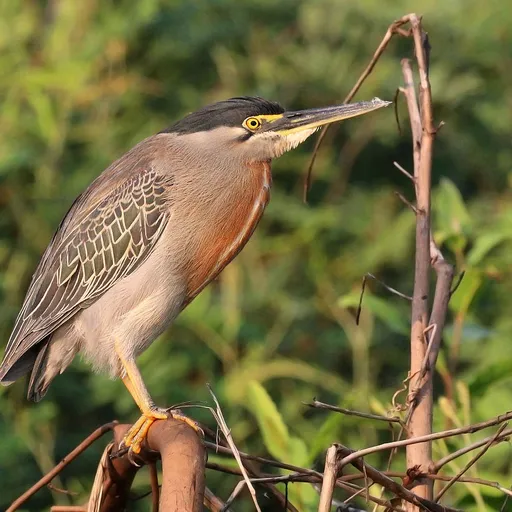
Striated Heron
Butorides striata
Least Concern
Overview
The striated heron (Butorides striata), also known as the mangrove heron or little green heron, is a small, sedentary heron species with a notable reputation for unique behavioural traits. It is classified as a species of least concern by the IUCN and is generally common within its range in South America.
Identification
- Adults feature a blue-grey back and wings, white underparts, a black cap, and a dark line extending from the bill to under the eye.
- Juveniles are browner above and heavily streaked below, distinguishing them from the plumage of adults.
- The bird measures between 35 and 48 cm in length, has short yellow legs, and weighs between 130 and 250 g.
Habitat
Widespread in tropical and warm temperate South America, ranging from central and southeastern Panama south to Río Negro Province in Argentina. It is generally a lowland bird found in marshes, lakes, and rivers, avoiding the Andes mountains and reaching altitudes of up to 800 m in Peru.
Diet
The striated heron mainly eats small fish, frogs, and aquatic insects, standing still at the water's edge to ambush prey. It sometimes uses bait, dropping a feather or leaf carefully on the water surface to attract fish that come to investigate.
Did you know?
An adult bird was once observed in a peculiar behaviour where, while on the nest, it grabbed a stick in its bill and made a rapid back-and-forth motion with the head, resembling a sewing machine's needle. The significance of this movement remains completely unknown, as it did not appear to serve the common purposes of compacting the nest, moving eggs, or dislodging parasites.
Sources
- Wikipedia · CC BY-SA 4.0
- Wikidata · CC0 1.0