
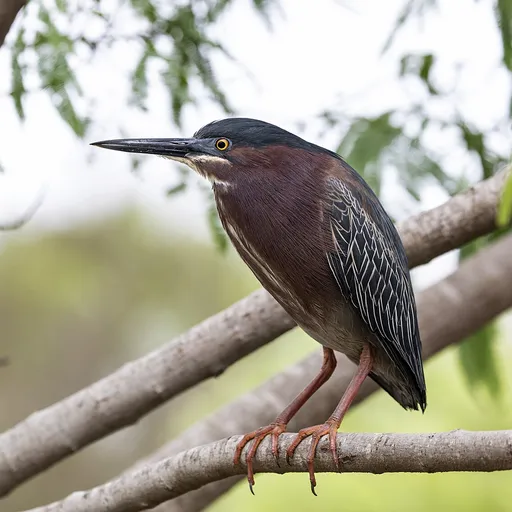
Green Heron
Butorides virescens
Listen
XC469642 · Audrey Plassio · Carroll Township (near Dillsburg), York County, Pennsylvania, United States · CC BY-SA 4.0
Overview
The green heron (Butorides virescens) is a small heron found across North and Central America. It was historically considered part of a larger group called the green-backed heron before being distinguished from its close relative, the striated heron.
Identification
- Adults feature a glossy, greenish-black cap and an iridescent greenish back that grades into gray, with a chestnut neck marked by white lines.
- Relatively small with a length of 41–46 cm and short yellow legs, often keeping the neck pulled tight against the body.
- Juveniles appear duller with brown and white streaking on the head, neck, and underparts, along with tan-splotched backs.
- The call is a loud, sudden kyow, accompanied by more subdued kuk calls and various courtship vocalisations.
Habitat
Green herons inhabit riparian zones, wetlands, ponds, lakes, and human-made canals throughout North and Central America. Northern populations migrate south to the southernmost US and northern South America for the winter, while some southern and island populations remain resident year-round.
Diet
They primarily consume small fish, frogs, and aquatic arthropods, but will eat almost any invertebrate or small vertebrate they can catch, including mice, lizards, and snakes. Foraging involves standing still in shallow water or on perches, and they are known to use bait-fishing by dropping items like insects or bread crumbs onto the water to attract prey.
Did you know?
The green heron is one of the few bird species recognised for using tools, commonly dropping bread crusts, feathers, or insects onto the water's surface to lure fish close enough to strike.