
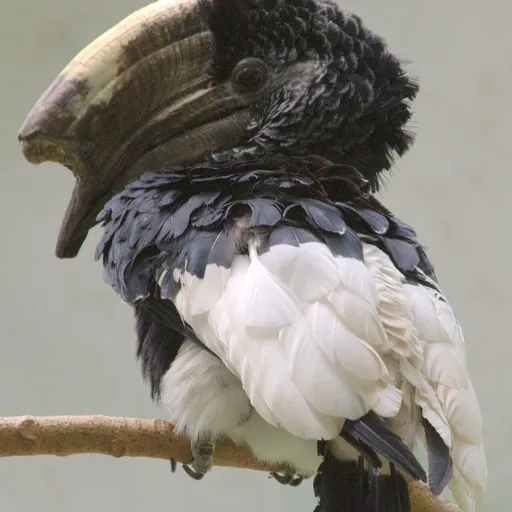
Black-and-white-casqued Hornbill
Bycanistes subcylindricus
Least Concern
Overview
The black-and-white-casqued hornbill (Bycanistes subcylindricus), also known as the grey-cheeked hornbill, is a large black and white bird belonging to the sub-Saharan hornbill genus Bycanistes. It is a monogamous species that nests in tree cavities and is currently assessed as Least Concern on the IUCN Red List.
Identification
- Moderately large bird measuring 60 to 70 cm in length with a wingspan of 70 to 96 cm.
- Distinctive black plumage on the upper body and wings contrasting with white plumage on the lower body, including black feathers amidst the white tail feathers.
- Features an oversized blackish or yellow-brownish bill topped with a large flattened casque that is significantly enlarged in males compared to females.
- Males weigh between 1 kg and 1.5 kg, while females are slightly smaller, weighing between 1 kg and 1.25 kg.
Habitat
This species inhabits wooded, tropical environments with high forest cover in central and western Africa, ranging from western Kenya to Côte d'Ivoire, including an isolated population in north Angola. It is predominantly found in Ivory Coast with smaller populations in surrounding West African countries such as Uganda, Kenya, Cameroon, Gabon, and Tanzania. Being highly arboreal, it is rarely seen on flat lands.
Diet
The diet consists primarily of fruits, particularly figs and other small fruits or pieces of larger fruits, though the bird also hunts lizards and the eggs of other birds. It does not drink water directly but instead hydrates through the moisture contained in its fruit-based diet. Foraging involves the precise and delicate handling of food using its beak in conjunction with its esophagus.
Did you know?
The bird possesses unusually mobile eyes that can move within their sockets, a rare trait in birds that allows it to see without moving its head. It can also display emotions by manipulating the feathers on top of its head to communicate its emotional state.
Sources
- Wikipedia · CC BY-SA 4.0
- Wikidata · CC0 1.0