
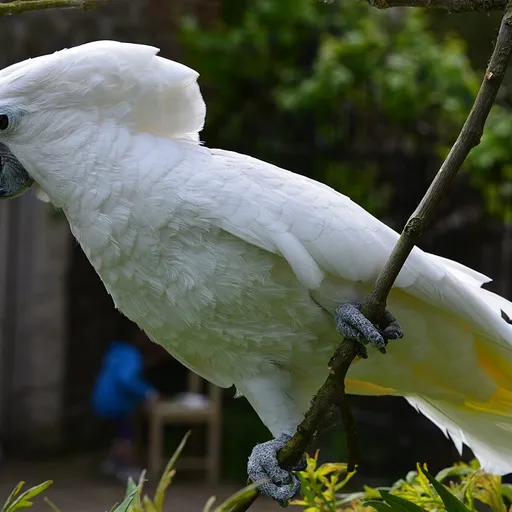
White Cockatoo
Cacatua alba
Endangered
Overview
The white cockatoo, also known as the umbrella cockatoo, is a medium-sized, all-white parrot endemic to the tropical rainforests of Indonesia. Classified as Cacatua alba, it is notable for its striking, semicircular head crest that resembles an umbrella when displayed.
Identification
- Plumage: Entirely white feathers, with pale yellow or lemon colour on the trailing edges of the wings and tail that becomes visible in flight.
- Size: Approximately 46 cm long; males are larger and possess broader heads and bigger beaks than females.
- Features: A dark grey beak and brown or black eyes; some mature females have reddish-brown irises, while adult males have dark brown or black eyes.
- Feet: Zygodactyl feet with two toes facing forward and two backward, allowing the bird to grasp objects with one foot while standing on the other.
Habitat
Found in lowland tropical rainforests, mangroves, and plantations, including coconut and agricultural land, typically below 900 m in elevation. Its range is restricted to the Moluccan islands of Halmahera, Bacan, Ternate, Tidore, Kasiruta and Mandioli in North Maluku, Indonesia, with local introduced populations on Obi, Bisa and Taiwan.
Diet
Feeds on berries, seeds, nuts, fruits such as papaya, durian, langsat and rambutan, and roots. During nesting, the diet includes insects and larvae, and they also consume large insects like crickets and small lizards such as skinks.
Did you know?
The species has a long history of cultural significance, having been popular in China during the Tang dynasty, where its depiction influenced artistic representations of Guan Yin holding a white parrot. It was also used in high-level diplomacy, with a white cockatoo serving as a gift in 1229 to seal the Fourth Crusade between the Holy Roman Emperor Frederick II and the Sultan of Babylon.
Sources
- Wikipedia · CC BY-SA 4.0
- Wikidata · CC0 1.0