
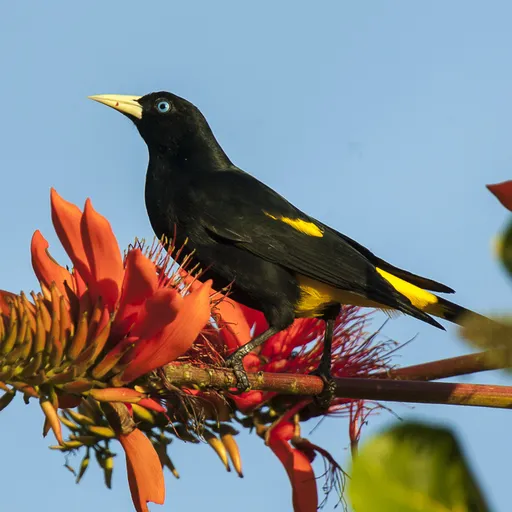
Yellow-rumped Cacique
Cacicus cela
Least Concern
Listen
Overview
The Cacicus cela, known as the yellow-rumped cacique, is a passerine bird in the family Icteridae. It is a gregarious species found across much of northern South America and parts of Central America, classified as Least Concern by the IUCN.
Identification
- Males measure approximately 28 cm in length and weigh about 104 g, while females are smaller at 23 cm and 60 g.
- The bird has a slim body with a long tail, blue eyes, and a pale yellow pointed bill.
- Plumage is predominantly black, distinguished by a bright yellow rump, tail base, lower belly, and wing epaulets; females appear duller than males.
- The male song is a complex mixture of fluting notes, cackles, wheezes, and occasional mimicry, with an active colony being audible from a considerable distance.
Habitat
This species inhabits open woodland or cultivation areas that contain large trees. Its range extends from Panama, Venezuela, and Trinidad south through Peru, Bolivia, and central Brazil, with rare sightings as far north as Mexico.
Diet
The yellow-rumped cacique feeds on large insects such as beetles, caterpillars, crickets, grasshoppers, and katydids, as well as spiders like orb-weavers. It also consumes nectar and fruit, including chupa-chupa and figs.
Did you know?
In Peruvian folklore, the bird is called paucarcillo and is the subject of a folktale from Moyobamba where it originated as a rumor-mongering boy wearing black pants and a yellow jacket who was transformed into a noisy bird by a fairy. Its appearance is traditionally thought to augur good news.
Sources
- Wikipedia · CC BY-SA 4.0
- Wikidata · CC0 1.0