
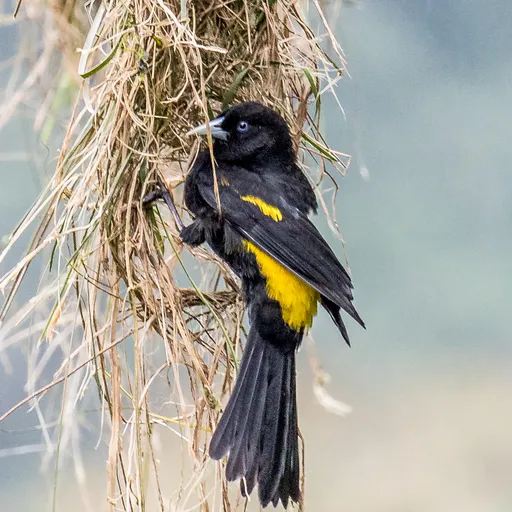
Mountain Cacique
Cacicus chrysonotus
Least Concern
Overview
The mountain cacique (Cacicus chrysonotus) is a species of bird in the family Icteridae. It is classified as Least Concern by the IUCN and is found across parts of South America, though its population is believed to be decreasing.
Identification
- Adults are almost entirely glossy black with a yellow lower back and rump.
- Some individuals exhibit yellow on the upperwing coverts.
- Males weigh approximately 92 to 98 g, while females are smaller at 64 to 67 g.
- Features a pale yellow-ivory to greenish ivory bill with a bluish gray base, and blue to bluish white irises.
Habitat
This species inhabits humid montane forest in subtropical to temperate zones between elevations of roughly 1,700 m and 3,500 m. Its range covers western Venezuela, the Colombian Andes, Ecuador, Peru, and central Bolivia.
Diet
The diet consists primarily of insects and other arthropods, supplemented by nectar and fruits. Foraging occurs mostly in trees, where the bird probes bark and epiphytes for prey. It feeds singly, in pairs, or in small flocks, and often joins mixed-species feeding flocks.
Did you know?
The male's song is uniquely described as consisting of pig-like squeals followed by high-pitched notes that accelerate into a rattle.
Sources
- Wikipedia · CC BY-SA 4.0
- Wikidata · CC0 1.0