
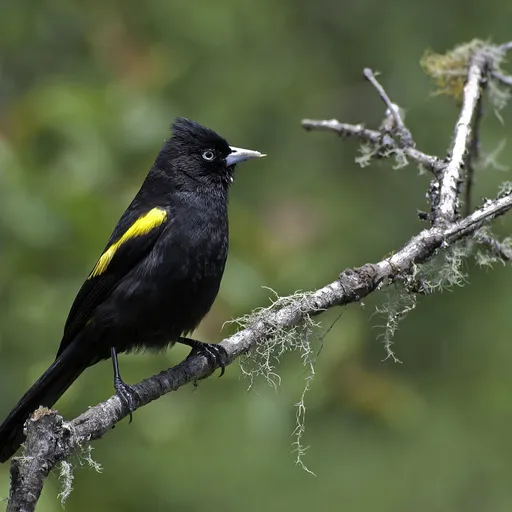
Golden-winged Cacique
Cacicus chrysopterus
Least Concern
Overview
The golden-winged cacique (Cacicus chrysopterus) is a species of blackbird found in parts of South America. It belongs to the family Icteridae and is currently classified as Least Concern on the IUCN Red List due to its large range and stable population.
Identification
- Males measure about 21 cm in length while females are slightly smaller at 19 cm.
- Adults are almost entirely black with bright yellow lower rump and inner wing coverts, paired with a pale bluish gray bill and black legs.
- The song is described as an unexpected and varied, musical series of sounds including 'rrrreee-chiroo, whooo, tooweetooweetoowee-teeeeay'.
Habitat
This species inhabits Yungas forest along the eastern Andes slope, as well as humid to mesic Chaco woodlands, gallery forest, and Atlantic forest in its larger range. It is found in Argentina, Bolivia, Brazil, Paraguay, and Uruguay, reaching elevations of up to 2,800 m in the west.
Diet
The bird feeds on insects, invertebrates, small vertebrates, nectar, and both wild and cultivated fruits. It typically forages by probing bark and epiphytes, sometimes hanging upside down, and often joins mixed-species flocks of up to 30 individuals during the non-breeding season.
Did you know?
Females construct long, purse-like nests woven from Marasmius fungal rhizomorphs, which are often placed hanging from branch tips over water. These solitary nests are occasionally taken over by piratic flycatchers or parasitised by shiny cowbirds.
Sources
- Wikipedia · CC BY-SA 4.0
- Wikidata · CC0 1.0