
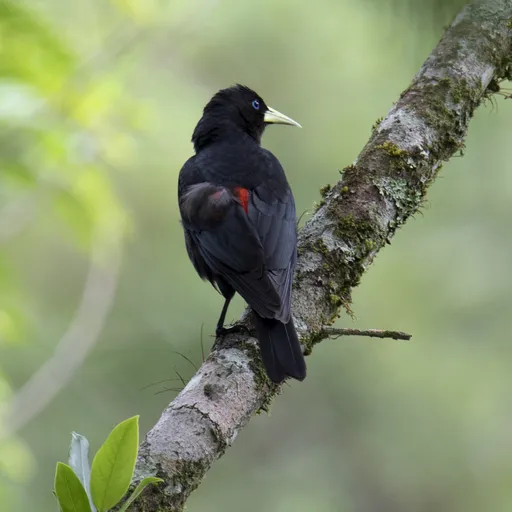
Red-rumped Cacique
Cacicus haemorrhous
Least Concern
Overview
The red-rumped cacique is a species of bird in the family Icteridae, found throughout mainland South America except Chile. It is assessed as a species of Least Concern by the IUCN and exists in three recognized subspecies with a disjunct distribution.
Identification
- Males average 29 cm in length, while females are slightly smaller at 25 cm.
- Plumage is mostly glossy black with a bright red lower back and rump, though females appear duller and the C. h. affinis subspecies is paler.
- Features an ivory-colored bill, black legs and feet, and a pale blue iris in males versus a brownish blue iris in females.
- Possesses a loud, complex vocal repertoire described as high, hoarse notes resembling the barking of a small dog.
Habitat
This species inhabits a wide range across South America, including primary and secondary forests, forest edges, clearings, and gallery forests. The C. h. affinis subspecies additionally breeds in small towns and suburbs, while Amazonian subspecies occur in plantations within forests. Elevations range from below 500 m in Colombia to 1,000 m in Peru and Brazil.
Diet
The red-rumped cacique feeds on insects, other arthropods, small vertebrates, fruits, and nectar. Foraging primarily takes place in trees, vines, and epiphytes, often in flocks that can exceed 80 individuals during the non-breeding season.
Did you know?
Females construct long bag- or purse-shaped nests woven from plant fibers and lined with leaves, which are often hung from isolated tree branches or palm fronds. These nests are occasionally raided by piratic flycatchers and parasitized by giant cowbirds.
Sources
- Wikipedia · CC BY-SA 4.0
- Wikidata · CC0 1.0