
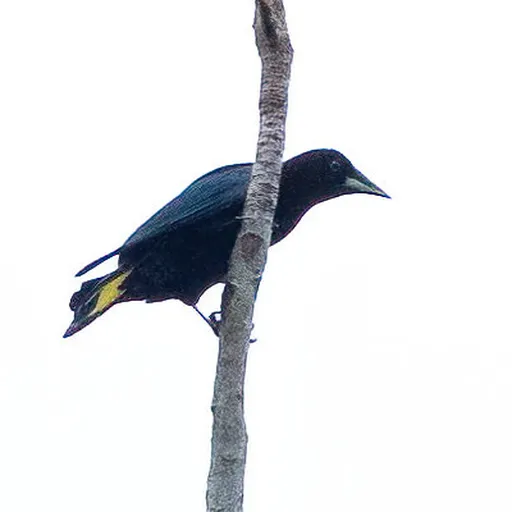
Band-tailed Cacique
Cacicus latirostris
Least Concern
Overview
The band-tailed cacique (Cacicus latirostris) is a species of bird in the family Icteridae, comprising oropendolas, New World orioles, and New World blackbirds. It is classified as a species of Least Concern by the IUCN, though its population is believed to be decreasing.
Identification
- Adults are mostly velvety black with chestnut crowns, napes, and upper backs, and wings that exhibit a bluish gloss.
- Males average approximately 33 cm in length and 118 g in weight, while females are smaller, averaging 24.5 cm and 75 g, and appear as a duller black.
- Central tail feathers are black, whereas the remaining tail feathers are yellow with black tips; the species features a pale blue iris and black legs.
- The bill varies from ivory-coloured with a dusky tip to having a dusky gray maxilla and an ivory mandible.
Habitat
This bird is native to the far western Amazon Basin, ranging from southern Colombia and eastern Ecuador through parts of Peru into the western parts of Brazil's Amazonas and Acre states. It primarily inhabits várzea forest along rivers and islands, occasionally appearing in terra firme forest near water, typically at elevations below 300 m.
Diet
The diet includes caterpillars, fruits, and is assumed to encompass other arthropods, small vertebrates, and nectar. Foraging usually occurs in small groups below the forest canopy, though the species may join much larger mixed-species feeding flocks.
Did you know?
The species possesses a complicated taxonomic history, having been known as the 'band-tailed oropendola' during its time in the genus Ocyalus. Its nest is constructed as an open-topped bag or purse suspended from a tree branch.
Sources
- Wikipedia · CC BY-SA 4.0
- Wikidata · CC0 1.0