
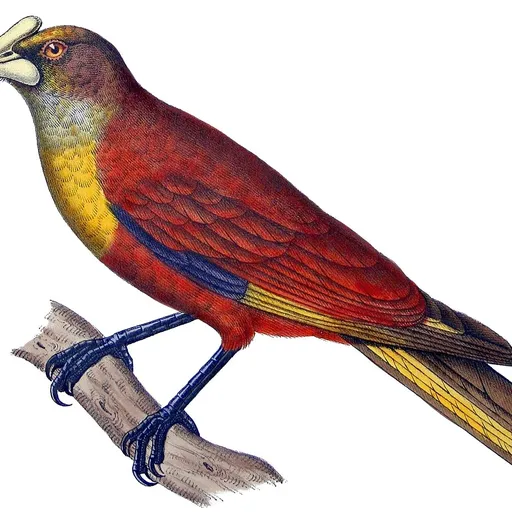
Casqued Cacique
Cacicus oseryi
Least Concern
Listen
XC242433 · Niels Krabbe · Orellana: s-bank Río Napo: between Añangu and Laguna Añangu, Ecuador · CC BY-SA 4.0
Overview
The casqued cacique (Cacicus oseryi) is a species of bird in the family Icteridae, found in the extreme western Amazon Basin. It is a sedentary resident that inhabits both terra firme and várzea forests across parts of Colombia, Ecuador, Peru, and possibly Brazil.
Identification
- Males average 37 cm in length, while smaller females average 29 cm, both possessing a prominent casque on the head.
- Adults are mostly rich chestnut with a tail that is dusky olive featuring bright yellow outer feathers, and wing flight feathers edged in yellow.
- The throat is grayish olive and the upper breast and neck sides are yellowish olive, contrasting with pale blue irises and black legs.
- The bill is usually dark gray on top with a yellow-green mandible, accompanied by a loud, electric, descending buzz in song.
Habitat
The species is restricted to the extreme western Amazon Basin, ranging from southern Colombia and eastern Ecuador through eastern Peru and into small parts of western Brazil. It inhabits both terra firme and várzea forests, typically found at lower elevations, generally below 300 m in Colombia and Ecuador, though up to 1,000 m in Peru.
Diet
The diet includes fruits and is assumed to include arthropods, small vertebrates, and nectar. The bird forages mostly in the forest interior, often observed in flocks with yellow-rumped caciques.
Did you know?
Males guard the breeding colony from predators such as monkeys and toucans, while the females build the elongated, open-topped bag nests from plant fibers.
Sources
- Wikipedia · CC BY-SA 4.0
- Wikidata · CC0 1.0