
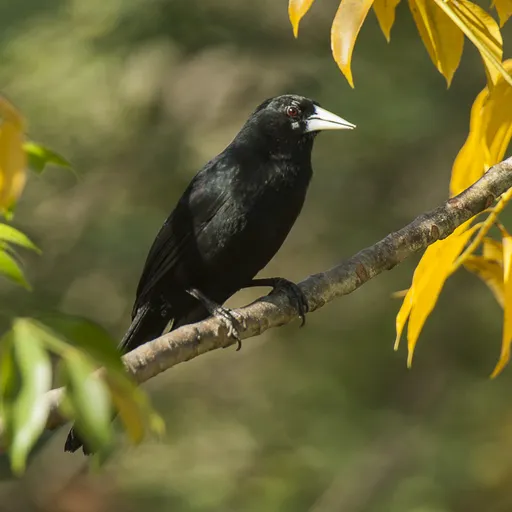
Solitary Cacique
Cacicus solitarius
Least Concern
Listen
XC242292 · Niels Krabbe · Sucumbíos: 'La Selva Jungle Lodge', n bank Río Napo, Ecuador · CC BY-SA 4.0
Overview
The solitary cacique (Cacicus solitarius) is a species of blackbird found across a wide distribution in South America. It is a fairly common species with a very extensive range, rated by the IUCN as a species of least concern.
Identification
- Male birds measure approximately 27 cm in length, while females are smaller at 23 cm.
- Entirely black plumage with dark irises.
- Possesses a large, white, chisel-shaped, and sharply pointed beak that distinguishes it from other black birds in its range.
- Vocalisations are delivered at a measured pace but are occasionally interrupted by gurgles and growls.
Habitat
Found in Argentina, Bolivia, Brazil, Colombia, Ecuador, Paraguay, Peru, Uruguay, and Venezuela, inhabiting subtropical or tropical moist lowland forests, swamps, and heavily degraded former forests. It typically occupies the mid-storey of the canopy or the shrubby understorey, often clambering among dense vines at altitudes up to 800 m.
Diet
Feeds on invertebrates, small vertebrates such as tree frogs, as well as fruit and nectar. It forages in tangled undergrowth, displaying acrobatic behaviour by sometimes hanging upside-down, and occasionally visits flowering trees higher in the canopy.
Did you know?
Unlike many other birds in its genus that build nests in colonies, the solitary cacique nests alone.
Sources
- Wikipedia · CC BY-SA 4.0
- Wikidata · CC0 1.0