
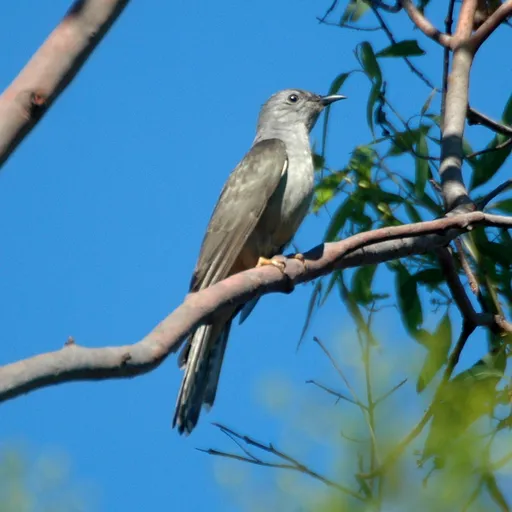
Sahul Brush Cuckoo
Cacomantis variolosus
Least Concern
Overview
The Sahul brush cuckoo, formerly known as the brush cuckoo, is a member of the cuckoo family native to Malesia, New Guinea, the Solomon Islands, and northern and eastern Australia. It is classified as Least Concern on the IUCN Red List.
Identification
- Length approximately 22–26 cm with a pale grey head, buff breast, and grey-brown back.
- Feet are olive-pink and the eye features a narrow, pale ring.
- Juvenile plumage is heavily barred dark brown.
- Wings are sharply pointed and backswept in flight, with grey-brown underwings featuring pale buff coverts and a white or pale buff bar.
- Call is described as a familiar sound of the Australian and Indonesian bush.
Habitat
Found in northern and eastern Australia, the Solomon Islands, New Guinea, Malaysia, and islands north of Australia, the species inhabits rainforests, rainforest edges, mangrove forests, secondary forests, and plantations. It is resident in parts of its range but migratory in southern Australia and may migrate locally in New Guinea and northern Melanesia.
Did you know?
The species is a brood parasite whose eggs are polymorphic, meaning females lay specific egg types tailored to the major host in the relevant region of their distribution.
Sources
- Wikipedia · CC BY-SA 4.0
- Wikidata · CC0 1.0