
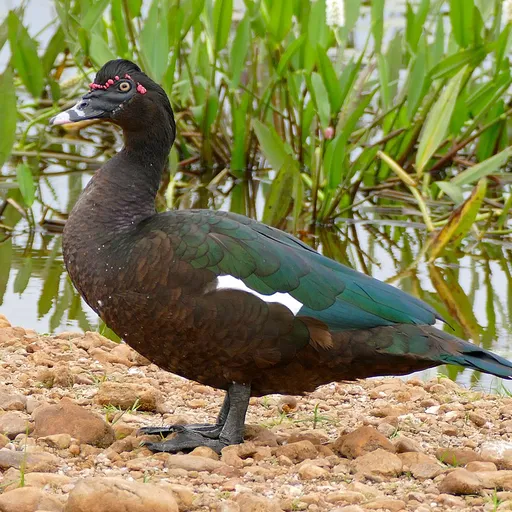
Muscovy Duck
Cairina moschata
Least Concern
Overview
The Muscovy duck (Cairina moschata) is a large, non-migratory waterfowl native to the Americas, ranging from Texas and Mexico south to Argentina and Uruguay. While classified as Least Concern by the IUCN, it has established feral populations in Europe, Australia, and New Zealand following domestication.
Identification
- Large duck with a wide, flat tail and long claws; males are notably heavier and longer than females.
- Predominantly black plumage with large white wing patches and iridescent, glossy feathers on the back and wings.
- Males feature a short nape crest, a black bill speckled with pale pink, and a prominent blackish or dark red knob at the bill base matching the bare facial skin.
- Males emit a low, breathy call, while females produce a quiet, trilling coo.
Habitat
Normally inhabits forested swamps, lakes, streams, and nearby grasslands or farm crops. The species often roosts in trees at night, though feral populations may nest in urban or suburban settings such as tree cavities, under shrubs, or on balconies.
Diet
Feeds on plant material including aquatic and terrestrial roots, stems, leaves, and seeds, obtained by grazing or dabbling in shallow water. Also consumes small fish, amphibians, reptiles, crustaceans, invertebrates, and worms.
Did you know?
The common name 'Muscovy' likely derives from the strong musk odour the duck exudes, rather than any connection to Moscow, as the term 'Muscovy' is an old reference to the region surrounding that city.
Sources
- Wikipedia · CC BY-SA 4.0
- Wikidata · CC0 1.0