
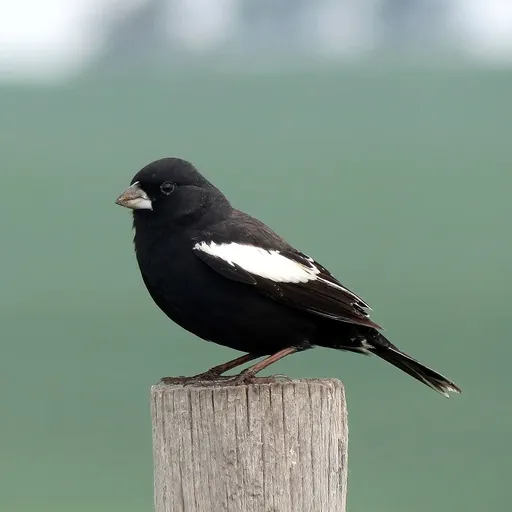
Lark Bunting
Calamospiza melanocorys
Least Concern
Overview
The lark bunting (Calamospiza melanocorys) is a medium-sized American bunting native to central and western North America. It is the most prevalent passerine species found in the grasslands of the continent and was designated the state bird of Colorado in 1931.
Identification
- Small songbird measuring 5.5–7.1 in (140–180 mm) in length with a short, thick, bluish bill.
- Breeding males feature an all-black body with a large white patch on the upper part of the wing.
- Non-breeding males and females appear similar, displaying a greyish-brown plumage with white stripes.
- A short tail with white tips is present on the feathers, and the song consists of a mix of whistles and trills.
Habitat
Breeding habitat consists of prairie regions in central Canada and the mid-western United States. In autumn, these birds migrate in flocks to winter in southern Texas, Arizona, and the high plateau of northern Mexico.
Diet
Lark buntings primarily forage on the ground, consuming insects in summer and seeds in winter. They sometimes take short flights in pursuit of insects and often feed in flocks outside of the nesting season.
Did you know?
Female mate choice is radically different from year to year, shifting preferences between male black coloring, wing patch size, and beak size. This temporal flexibility in selection parallels the phenomenon seen in Darwin's finches regarding changing food supplies.
Sources
- Wikipedia · CC BY-SA 4.0
- Wikidata · CC0 1.0