
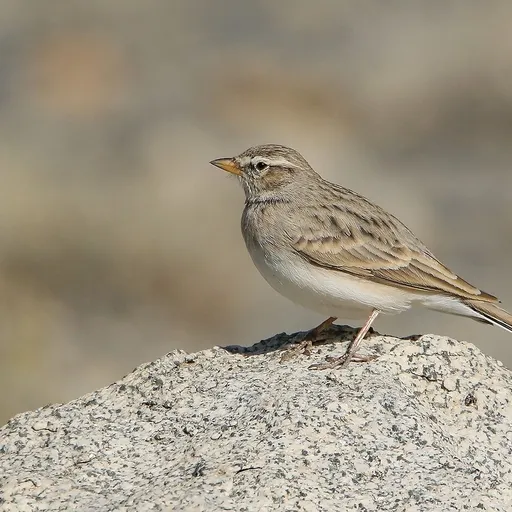
Hume's Short-toed Lark
Calandrella acutirostris
Least Concern
Overview
Hume's short-toed lark (Calandrella acutirostris) is a species of lark in the family Alaudidae found in south-central Asia. The name commemorates the British naturalist Allan Octavian Hume, who described the species, and it is also known as Hume's lark or Karakoram short-toed lark.
Identification
- Length of 13 to 14 cm (5.1 to 5.5 in) with a slightly smaller beak and duller, slightly darker plumage compared to the greater short-toed lark.
- Brown crown with slight diffuse streaking, rufous-brown cheeks, and a white supercilium.
- Upper parts are greyish-brown or sandy brown with darker streaking, while wings are greyish-brown with black barring and pale feather tips.
- Underparts are mostly whitish with a dark neck patch and a buffish-grey breast band; the voice includes a shrill "trree" and a rolling "drreep".
Habitat
The species is found in south-central Asia, ranging from Iran and Kazakhstan to China. Subspecies C. a. acutirostris occurs from north-eastern Iran and eastern Kazakhstan to western China, while the Tibet short-toed lark (C. a. tibetana) is found from north-eastern Pakistan to the Tibetan Plateau.
Did you know?
The alternate name "short-toed lark" is also used for three other species in the genus Calandrella, and the alternate name "lesser short-toed lark" should not be confused with a different species, Alaudala rufescens.
Sources
- Wikipedia · CC BY-SA 4.0
- Wikidata · CC0 1.0