
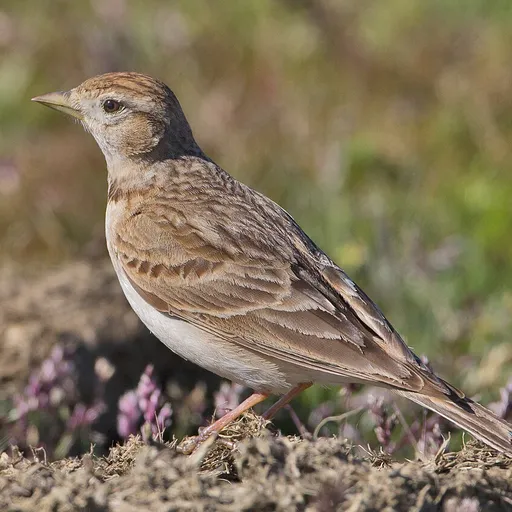
Greater Short-toed Lark
Calandrella brachydactyla
Least Concern
Listen
XC478478 · Milan Ruzic · Municipality of Alibunar (near Alibunar), Južnobanatski okrug, Vojvodina, Serbia · CC BY-SA 4.0
Overview
The greater short-toed lark is a small passerine bird that forms part of a larger complex with significant genetic flow between its various subspecies. It is a fairly common wanderer to northern and western Europe during the spring and autumn migration periods.
Identification
- A small, pale lark that is smaller than a skylark, featuring dark-streaked greyish-brown upperparts and white underparts.
- Possesses a strong, pointed bill that is pinkish with a grey culmen, along with a pale supercilium and dark patches on each side of the neck.
- The song varies significantly, ranging from a dry twittering to a more varied and imitative melody.
Habitat
This species prefers dry open country and cultivation, specifically crop land and dry pastures with short shrubs. It breeds across southern Europe, north-west Africa, and the Palearctic, ranging from Turkey and southern Russia to Mongolia, while most populations migrate to winter in Africa and South Asia.
Diet
The bird feeds on seeds and insects, with insect consumption being particularly important during the breeding season. In the evenings, they roost in open ground by squatting in small depressions made in the soil.
Did you know?
In colonial India, these birds were hunted for food as a substitute for ortolans. They can also become a bird strike risk to aircraft when attracted in large flocks to short grass areas along aerodromes during winter.
Sources
- Wikipedia · CC BY-SA 4.0
- Wikidata · CC0 1.0