
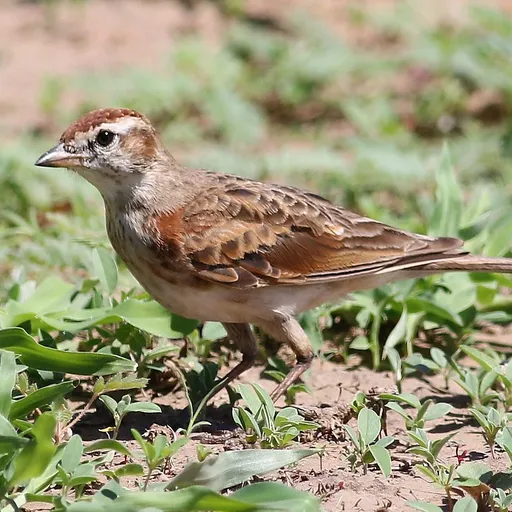
Red-capped Lark
Calandrella cinerea
Least Concern
Listen
XC1149005 · Kileo Jumah · Ngorongoro Conservation Area (crater floor), Arusha, Tanzania · CC0 1.0
Overview
The red-capped lark (Calandrella cinerea) is a small passerine bird that breeds in the highlands of eastern Africa, extending southwards to Angola and the Cape of South Africa. It is classified as Least Concern on the IUCN Red List.
Identification
- Measures 14–15 cm in length with a typically upright stance.
- Distinguished by a rufous cap, white underparts, and red shoulders, while upperparts are streaked grey to brown.
- A short head crest is normally inconspicuous but raised during courtship displays.
- Song delivered in display flight consists of a jumble of whistles and short trills, often including imitation of other birds; call is a tshwerp similar to a sparrow.
Habitat
Inhabits short grassland and fallow agricultural areas. In eastern Africa, it is found in highlands normally above 1000 m, but occurs down to sea level in suitable habitat in the cooler southern parts of its range.
Diet
Forages on bare ground or in very short grass, moving with short runs to feed on seeds and insects. It is sometimes found in flocks consisting of hundreds of birds.
Did you know?
The nest is built primarily by the female in four to five days, creating an open cup set into the ground and lined with fine grass and rootlets. After incubation, the chicks are cared for by both parents for a period between nine and 18 days.
Sources
- Wikipedia · CC BY-SA 4.0
- Wikidata · CC0 1.0