
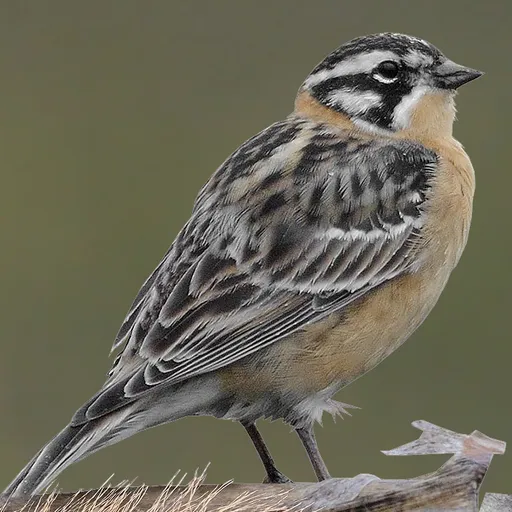
Smith's Longspur
Calcarius pictus
Least Concern
Overview
Smith's longspur (Calcarius pictus) is a small ground-dwelling passerine classified as Least Concern on the IUCN Red List. As a member of the family Calcariidae, it is characterised by its preference for open habitats across North America.
Identification
- Size: 15–17 cm in length with a 25 cm wingspan and a weight of 20–31 g.
- Plumage: Short cone-shaped bills, streaked backs, and dark tails with white outer rectrices; breeding males display pumpkin-orange throats and underparts contrasting with intricate black-and-white facial patterns and pronounced white lesser coverts.
- Song: A sweet warble inflected at the end, reminiscent of the chestnut-sided warbler, accompanied by a dry rattle call similar to a shortened female brown-headed cowbird.
Habitat
Breeds in open grassy areas near the tree line in northern Canada and Alaska. Winters in open fields, including airports, in the south-central United States. Migration is elliptical, with northbound birds staging in Illinois and southbound birds flying over the Great Plains.
Diet
Primarily a ground-feeding seed-eater that forages on the ground and gathers in flocks outside the nesting season. Supplements its diet with insects and spiders in summer, with nestlings mainly fed invertebrates such as spiders, insects, and snails.
Did you know?
The species was originally described in 1831 by William Swainson as the 'Painted Bunting,' unaware that this name was already in use by another species described by Linnaeus in 1758.
Sources
- Wikipedia · CC BY-SA 4.0
- Wikidata · CC0 1.0