
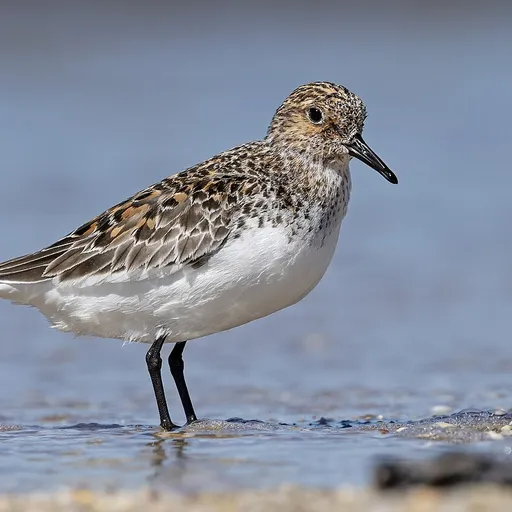
Sanderling
Calidris alba
Least Concern
Listen
XC938617 · Sonothèque ADVL · Embouchure du Thar (Saint-Pair-sur-Mer), Manche, Normandie, France · CC0 1.0
Overview
The sanderling, Calidris alba, is a small wading bird and circumpolar Arctic breeder that nests on the coldest tundra north of the 5°C July isotherm. As a long-distance migrant, it winters on marine coasts across South America, western and southern Europe, Africa, and Australia.
Identification
- A small, plump sandpiper measuring 18–20 cm in length, similar in size to a dunlin but stouter with a thicker bill.
- Winter plumage is very pale, almost white with a dark shoulder patch, while later summer plumage features brick-red face and throat.
- Notable for lacking a hind toe, a feature that distinguishes it from other small wading birds.
- Exhibits a characteristic 'bicycling' action of the legs when running along sandy beaches, stopping frequently to pick food items.
Habitat
Breeding habitat consists of coastal tundra on dry stony areas near wet zones, ranging from 60 to 800 m above sea level. During winter and migration, it primarily inhabits coastal sandy beaches, tidal sand and mud flats, and the shores of lakes and rivers, though it may occasionally occur on rocky shores.
Diet
Sanderlings feed on invertebrates buried in the sand in the upper intertidal zone, such as small crabs, isopods, and mole crabs. They forage by plunging their beaks into the sand at random when the tide is in, taking advantage of the softer substrate to penetrate deeper. In spring, they consume large numbers of horseshoe crab eggs, while on nesting grounds they eat mainly insects and some plant material.
Did you know?
The sanderling is one of the few birds recognised to have no hind toe, a trait that led to historical suggestions it should be placed in its own monotypic genus, though it is now retained within Calidris. Its name derives from Old English meaning 'sand-ploughman', referencing its habit of digging into the beach.
Sources
- Wikipedia · CC BY-SA 4.0
- Wikidata · CC0 1.0