
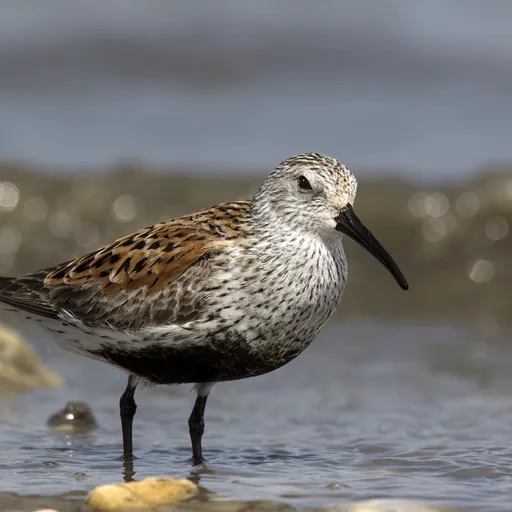
Dunlin
Calidris alpina
Near Threatened
Listen
XC1107915 · Sonothèque ADVL · Arrondissement of Avranches (near Vains), Manche, Normandy, France · CC0 1.0
Overview
The dunlin (Calidris alpina) is a small wader in the genus Calidris and one of the most common species within its breeding and wintering ranges. It is a circumpolar breeder that is highly gregarious in winter, often forming large flocks on coastal mudflats or sandy beaches.
Identification
- In breeding plumage, it displays a distinctive black belly that no other similar-sized wader possesses, while in winter it is greyish-brown above and white below.
- Adults possess black legs and a slightly decurved bill that is blunt in life, featuring a soft tip filled with blood and nerve endings.
- It is similar in size to a common starling but is stouter with a longer, thicker bill.
- The call is a typical sandpiper 'chreep', and the display song is a harsh trill.
Habitat
Dunlins are circumpolar breeders in Arctic or subarctic regions, with birds from western Europe staying on western and southern European and north-west African coasts. Those breeding in far northern Europe and Asia are long-distance migrants, wintering as far south as Africa, south-east and west Asia.
Diet
On the nesting grounds, the main part of the diet consists of insects, particularly Diptera, while in coastal areas it eats molluscs, worms, and crustaceans. It forages with a characteristic 'sewing machine' feeding action, methodically picking small food items.
Did you know?
At the tip of its bill is a soft covering that fills with blood and many nerve endings, forming a sensitive probe used to locate invertebrate prey in mud and sand, which makes the bill blunt in life despite looking sharp in dead specimens.
Sources
- Wikipedia · CC BY-SA 4.0
- Wikidata · CC0 1.0