
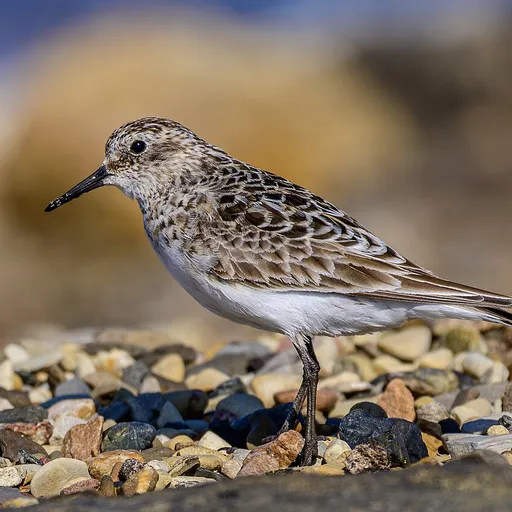
Baird's Sandpiper
Calidris bairdii
Least Concern
Listen
XC613406 · Doug Hynes · Churchill, MB, Canada · CC BY-SA 4.0
Overview
Baird's sandpiper (Calidris bairdii) is a small shorebird classified as Least Concern on the IUCN Red List. It is a long-distance migrant that breeds in the northern tundra and winters in western and southern South America.
Identification
- Adults feature black legs and a short, straight, thin dark bill.
- Upperparts are dark brown, while underparts are mainly white with a black rump patch.
- The head and breast display light brown colouring with dark streaks.
- Long wings extend beyond the tail when the bird is on the ground, a trait shared only by the white-rumped sandpiper.
Habitat
Breeding occurs in the northern tundra, stretching from far eastern Siberia to western Greenland, usually in dry locations with low vegetation. During migration and winter, the species uses lake shores and sparse grassland at extreme high altitudes in the Andes, reaching up to 4,700 m. It is also a rare vagrant to western Europe.
Diet
These birds forage by moving across mudflats, picking up food by sight. Their diet mainly consists of insects, supplemented by some small crustaceans.
Did you know?
Baird's sandpiper might have hybridised with the buff-breasted sandpiper.
Sources
- Wikipedia · CC BY-SA 4.0
- Wikidata · CC0 1.0