
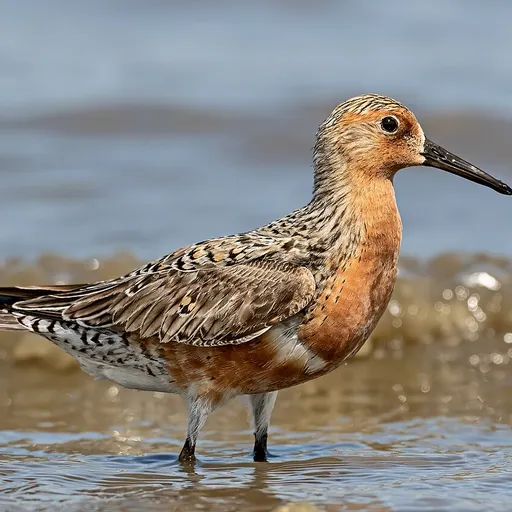
Red Knot
Calidris canutus
Near Threatened
Listen
XC1088498 · Sonothèque ADVL · Genêts, Manche, Normandie, France · CC0 1.0
Overview
The red knot, or just knot, is a medium-sized shorebird that breeds in the tundra and Arctic Cordillera of far northern Canada, Europe, and Russia. It is the type species of the genus Calidris and is classified as Near Threatened on the IUCN Red List.
Identification
- Measures 23–26 cm long with a wingspan of 47–53 cm, ranking as the third or fourth largest Calidris sandpiper.
- Winter plumage is uniformly pale grey, while breeding plumage features mottled grey upperparts and a cinnamon face, throat, and breast.
- In flight, it is easily identified by its white wing bar and grey rump and tail.
- Produces a low monosyllabic knu when flying in flocks and a disyllabic knuup-knuup during migration.
Habitat
Breeding occurs in moist tundra across the high Arctic from June to August, with non-breeding populations moving to coastal areas globally. North American breeders migrate to Europe and South America, while Eurasian populations winter in Africa, Papua New Guinea, Australia, and New Zealand. The species exhibits a circumpolar distribution with a total range estimated between 100,000 and 1,000,000 km².
Diet
On breeding grounds, the red knot feeds on spiders, arthropods, larvae, and some plant material via surface pecking. Elsewhere, it consumes hard-shelled prey such as bivalves, gastropods, and small crabs, which are ingested whole and crushed by a muscular gizzard. It is a tactile feeder that probes mud for unseen prey using Herbst corpuscles in its bill to sense pressure changes, and relies heavily on horseshoe crab eggs during migration.
Did you know?
The common English name 'knot' is onomatopoeic, derived from the bird's grunting call note first attested as 'Knottys' in 1452. Additionally, the species epithet canutus references King Canute and a myth regarding the bird foraging along the tide line, despite having no historical foundation.
Sources
- Wikipedia · CC BY-SA 4.0
- Wikidata · CC0 1.0