
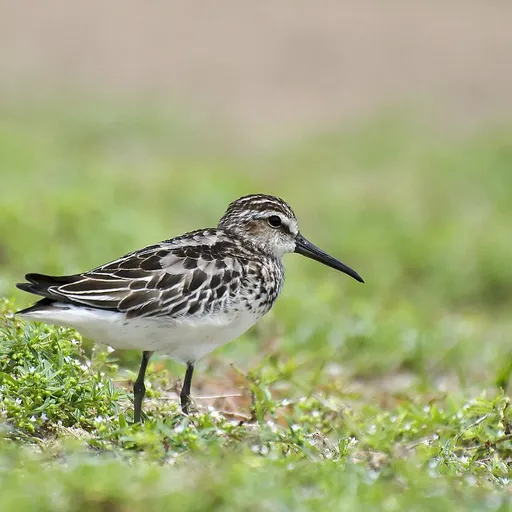
Broad-billed Sandpiper
Calidris falcinellus
Vulnerable
Listen
XC671794 · Alfonso Maffezzoli · Riserva Statale Le Cesine, Lecce, Puglia, Italy · CC0 1.0
Overview
The broad-billed sandpiper (Calidris falcinellus) is a small wader classified as Vulnerable on the IUCN Red List. It is a strongly migratory species that has shown signs of population decline, likely exceeding 30% over the past three generations.
Identification
- Length of 16–18 cm, slightly smaller than a dunlin but larger than a little stint, with a longer, straighter bill that has a distinctly down-kinked tip.
- Breeding adults feature dark brown upperparts with pale fringes, white underparts with blackish breast markings, and a distinctive double (split) supercilium.
- Winter plumage is much paler and greyer above, resembling a winter dunlin, while retaining the distinct head pattern.
- Contact calls include a dry, whistling 'dree-it' and a clicking 'dik dik', similar to the little stint.
Habitat
This species breeds in wet taiga bogs in Arctic northern Scandinavia and Siberia, and migrates to winter in easternmost Africa, south and south-east Asia, and Australasia. It is gregarious and often forms flocks with other scolopacid waders, particularly dunlins, though it is rare on passage in western Europe due to its south-easterly migration route.
Diet
The bird forages in soft mud on marshes during the summer and on coasts in winter, primarily picking up food by sight. Its diet consists mostly of insects and other small invertebrates.
Did you know?
The scientific specific name falcinellus is a diminutive from the Latin falx, meaning 'a small sickle'. Although the bill is slightly broader than in most other Calidris species, this 'museum' name characteristic is rarely evident in the field.
Sources
- Wikipedia · CC BY-SA 4.0
- Wikidata · CC0 1.0