
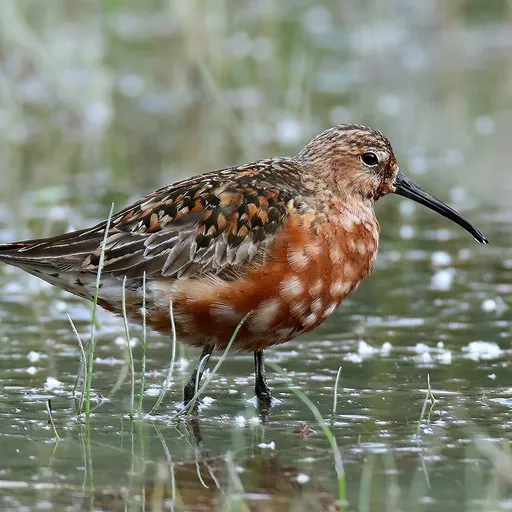
Curlew Sandpiper
Calidris ferruginea
Vulnerable
Listen
XC1041162 · Sonothèque ADVL · Vains, Manche, Normandie, France · CC0 1.0
Overview
The curlew sandpiper (Calidris ferruginea) is a small wader and long-distance migrant that breeds in the Siberian Arctic and overwinters in Africa, Oceania, and southern Eurasia. It is currently listed as a Vulnerable species on the IUCN Red List due to habitat loss and climate change impacts on its breeding productivity.
Identification
- Size: 18–23 cm in length with a 38–46 cm wingspan; possesses a black bill (32–44 mm) and dark grey to black feet.
- Plumage: Breeding plumage is striking with deep rusty colours on the front, more intense in males, while non-breeding plumage features brown-grey upperparts and white underparts.
- Markings: A large white patch on the rump, occasionally barred with red, and a distinctive white wing stripe visible in flight.
- Voice: Males perform a song lasting 10–15 seconds composed of trilled doublets and whine calls, while both sexes use a sharp 'whik' alarm call.
Habitat
It breeds in the bogs and coastal lowlands of the Siberian extreme high Arctic tundra, specifically from the Yamal Peninsula to Kolyuchin Bay. During the non-breeding season, it occupies tidal mudflats, salt pans, and wetland edges in Africa, Australasia, and coastal South Asia.
Diet
This omnivorous bird forages in large flocks within wetlands for various invertebrates, including crabs and insects.
Did you know?
Its breeding success is inversely linked to lemming populations; in years with many lemmings, predators hunt them instead of curlew sandpiper chicks. The male constructs a faux nest on the ground to present to the female during courtship, a behaviour that is not actual nest-building.
Sources
- Wikipedia · CC BY-SA 4.0
- Wikidata · CC0 1.0