
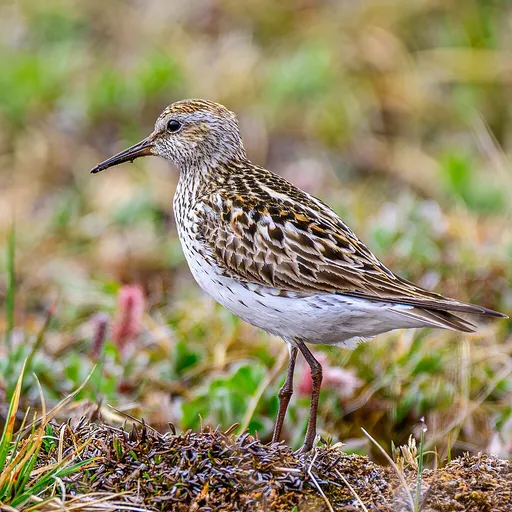
White-rumped Sandpiper
Calidris fuscicollis
Vulnerable
Overview
The white-rumped sandpiper (Calidris fuscicollis) is a small migratory shorebird classified as Vulnerable on the IUCN Red List. It breeds in the northern tundra of Canada and Alaska, where it inhabits marshy, heavily vegetated areas. This species is one of the most extreme long-distance migrants in the world, wintering primarily in southern South America and the Caribbean.
Identification
- Measures 15–18 cm in length with a wingspan of 36–38 cm.
- Distinctive white rump visible in flight, with long wings extending 5–10 mm beyond the tail.
- Dull grey-brown upperparts with a white eye stripe, medium-length thin dark beak, and very dark legs.
- Emits a metallic 'tzeep' call that resembles two pebbles scraping together.
Habitat
Breeds in the marshy, heavily vegetated, hummocky arctic tundra of Alaska and Canada. During migration, it occupies various wetland types, and in winter it inhabits freshwater and saltwater habitats such as lagoons, estuaries, and marshes. The species generally avoids sandy beaches and fast-moving water.
Diet
The diet consists primarily of small invertebrates, including molluscs, crustaceans, polychaetes, annelids, and insects, with occasional consumption of seeds and moss. On mudflats, the bird forages by probing in shallow waters and mud, whereas in the tundra it probes deeply into moss and vegetation.
Did you know?
Unlike most sandpipers in its genus where incubation duties are shared, only the female incubates the eggs, a trait that has been independently lost in this species. This behaviour is linked to the species being polygynous, as males leave the breeding grounds after mating to explore other options.
Sources
- Wikipedia · CC BY-SA 4.0
- Wikidata · CC0 1.0