
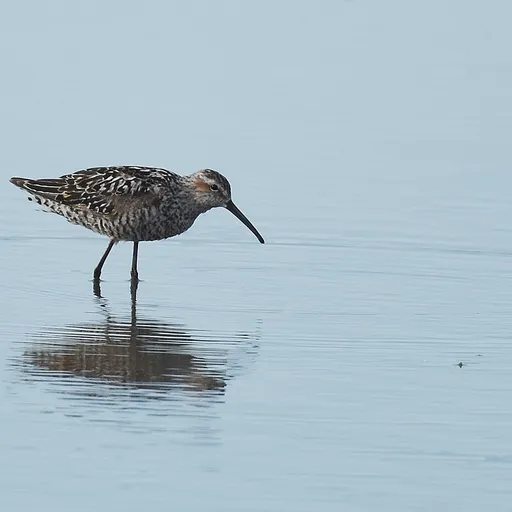
Stilt Sandpiper
Calidris himantopus
Near Threatened
Overview
The stilt sandpiper is a small shorebird belonging to the genus Calidris, where its closest relative is the curlew sandpiper. Currently listed as Near Threatened, it is a long-distance migrant that breeds in North America and winters primarily in South America.
Identification
- Length of 18–23 cm with a wingspan of 37–42 cm, resembling the curlew sandpiper but with straighter, only slightly curved bills.
- Legs are long and greenish-yellow rather than black, featuring a distinctive white rump and pale supercilium.
- Breeding adults display heavy blackish bars on a white belly with reddish-orange patches near the eye, while winter plumage is grey above and white below.
- In flight, the species is distinguished by the lack of an obvious wing bar.
Habitat
Breeding occurs in the open arctic tundra of northern Alaska and Canada, while wintering takes place mainly in central South America from southern Peru to southern Brazil, with smaller numbers reaching North America. On migration, flocks rest on the muddy margins of freshwater pools in eastern North America, and the bird occasionally appears as a rare vagrant in western Europe, Japan, and Australia.
Diet
Foraging primarily on muddy pool margins, the bird picks up food by sight and often jabs into the mud like a dowitcher. Its diet consists mainly of insects and other invertebrates such as molluscs, as well as seeds and the leaves and roots of aquatic plants.
Did you know?
The specific name himantopus translates to 'strap foot' or 'thong foot' in reference to the bird's long, stilt-like legs. The genus name derives from a term used by Aristotle for a gray-colored waterside bird.
Sources
- Wikipedia · CC BY-SA 4.0
- Wikidata · CC0 1.0