
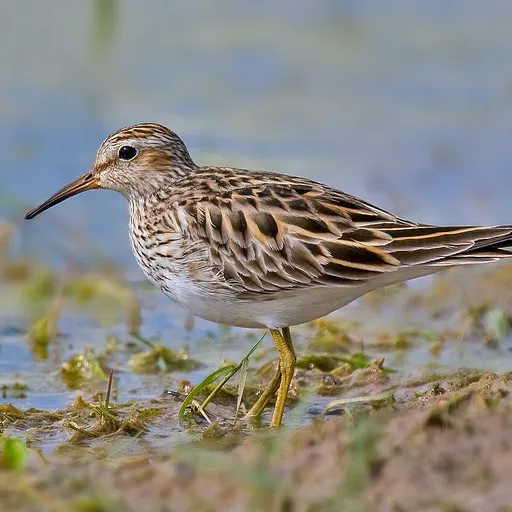
Pectoral Sandpiper
Calidris melanotos
Least Concern
Listen
XC250563 · Niels Krabbe · Cotopaxi: Laguna de Limpiopungo, Ecuador · CC BY-SA 4.0
Overview
The pectoral sandpiper (Calidris melanotos) is a small, migratory wader that breeds in arctic regions of North America and Asia, wintering primarily in South America and Oceania. It is currently listed as Least Concern on the IUCN Red List.
Identification
- Length 19–23 cm with a wingspan of 37–46 cm.
- Grey-brown back that is browner in summer males and greyer in winter.
- Distinctive grey breast sharply demarcated at its lower edge, which is blacker and spotted whitish in breeding males.
- Olive bill with a darker tip and yellowish legs.
Habitat
This species breeds in the boggy tundra of northern Asia and a range extending from Alaska to central Canada. American and most Asian populations winter in South America, while some Asian birds winter in southern Australia and New Zealand. On migration and during winter, they are typically found in freshwater habitats.
Diet
Pectoral sandpipers forage on grasslands and mudflats, picking up food by sight or occasionally by probing. Their diet consists mainly of arthropods, such as flies, larvae, spiders, and crustaceans, along with seeds.
Did you know?
During the breeding season, males develop a fat sac on their breast to enhance their courtship display, which involves puffing up the chest. This species has also produced hybrid offspring with the curlew sandpiper, known as Cox's sandpiper.
Sources
- Wikipedia · CC BY-SA 4.0
- Wikidata · CC0 1.0