
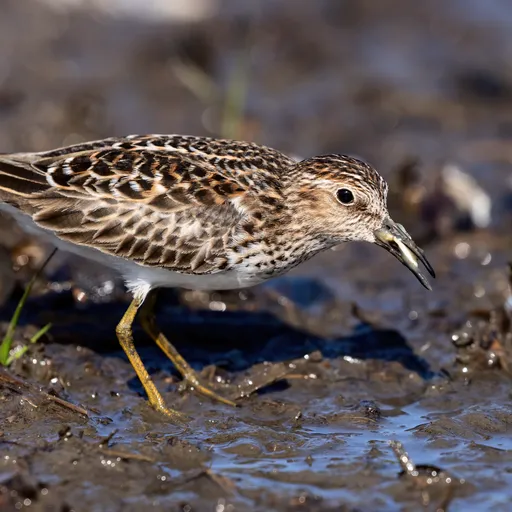
Least Sandpiper
Calidris minutilla
Near Threatened
Overview
The least sandpiper (Calidris minutilla) is the smallest shorebird, with the specific name minutilla deriving from Medieval Latin for "very small". It is classified as Near Threatened on the IUCN Red List and is most closely related to the white-rumped sandpiper.
Identification
- Plumage: Breeding adults are brown with dark streaks on top and white underneath; winter plumage is grey above, while juveniles feature rufous colours and white mantle stripes.
- Size and Build: Measures 13–15 cm in length and weighs 19–30 g, appearing more compact and shorter-necked than similar species like the long-toed stint.
- Features: Possesses yellow-green legs and a short, thin, dark bill, with a light line above the eye and a dark crown in breeding plumage.
- Distinguishing Marks: Features a stronger wingbar and somewhat duller colouring compared to its Asian counterpart, the long-toed stint.
Habitat
Breeding occurs on the tundra or in bogs of the northern North American continent, where the bird nests on the ground near water. During migration and the non-breeding season, it ranges through the southern United States, Mexico, Central America, the Caribbean, and northern South America, with rare occurrences in western Europe.
Diet
These birds forage on mudflats by picking up food by sight or probing, primarily consuming small crustaceans, insects, and snails. While migrating through Delaware Bay, they feed on worms, detritus, and the eggs of horseshoe crabs.
Did you know?
The female lays exactly four eggs in a shallow scrape lined with grass and moss, and although both parents incubate, the female often leaves before the eggs hatch, while the young are capable of feeding themselves and flying within two weeks of birth.
Sources
- Wikipedia · CC BY-SA 4.0
- Wikidata · CC0 1.0