
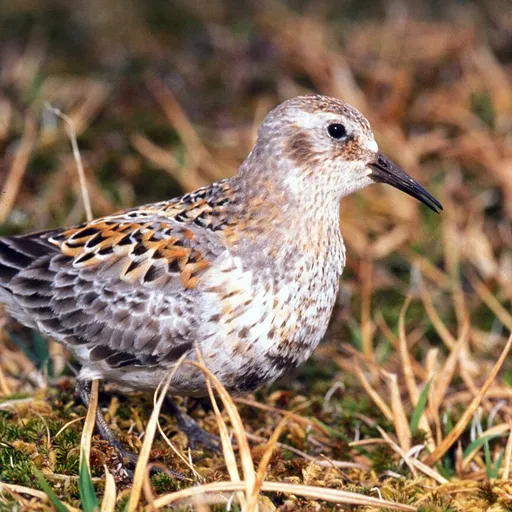
Rock Sandpiper
Calidris ptilocnemis
Least Concern
Overview
The rock sandpiper (Calidris ptilocnemis) is a small, hardy shorebird within the family Scolopacidae. It breeds in arctic and subarctic regions of Alaska and Russian peninsulas, closely related to the purple sandpiper. The species is currently classified as Least Concern on the IUCN Red List.
Identification
- Short yellow legs and a medium, thin, dark bill.
- Dark upper body with a slight purplish gloss, contrasting with mainly white underparts.
- Breast smeared with grey and a black rump.
- The nominate subspecies from the Pribilof Islands displays a bold black belly patch in breeding plumage.
Habitat
This species reproduces in northern tundra habitats, typically favouring drier, desolate areas with limited vegetation such as lichen, moss, and sparse grasses. During winter, birds migrate south to rocky, ice-free Pacific coasts, where they can form large flocks.
Diet
Rock sandpipers forage on rocky coasts, consuming primarily insects, mollusks, and marine worms, along with some plant material. They often feed up to their breast in water and swim, relying on high-quality prey such as the bivalve Macoma balthica in harsh Pacific conditions.
Did you know?
The subspecies exhibit a leap-frog migration pattern, where birds from more northerly breeding grounds pass south of those from more southerly breeding areas during winter. They roost on rocks just above the high tide spray, close to their feeding grounds.
Sources
- Wikipedia · CC BY-SA 4.0
- Wikidata · CC0 1.0