
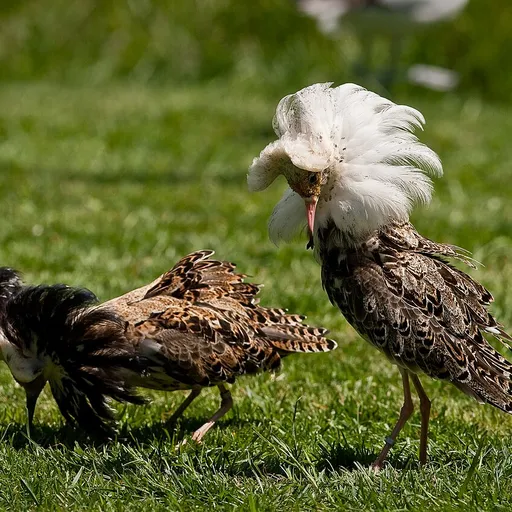
Ruff
Calidris pugnax
Least Concern
Listen
XC1157164 · Teet Sirotkin · Stormyra, Kongsfjord, Finnmark, Norway · CC BY-SA 4.0
Overview
The ruff is a medium-sized wading bird that breeds in marshes and wet meadows across northern Eurasia. This highly gregarious sandpiper is migratory and sometimes forms huge flocks in its winter grounds, which include southern and western Europe, Africa, southern Asia and Australia.
Identification
- Medium to large wader with a long neck, heavy body and small head.
- Distinctive breeding male plumage includes brightly coloured head tufts, bare orange facial skin, extensive black on the breast, and a large ornamental collar.
- Non-breeding males and females have grey-brown upperparts and mainly white underparts.
- Long legs that are variable in colour, being dark greenish in juveniles, and pink to orange in adults.
- Deeper, slower wing stroke in flight with a thin, indistinct white bar on the wing and white ovals on the sides of the tail.
Habitat
The ruff is a migratory species, breeding in wetlands in colder regions of northern Eurasia, and spends the northern winter in the tropics, mainly in Africa. It breeds in extensive lowland freshwater marshes and damp grasslands, avoiding barren tundra and areas badly affected by severe weather. When not breeding, the birds use a wider range of shallow wetlands, such as irrigated fields, lake margins, and mining subsidence and other floodlands.
Diet
The ruff forages in wet grassland and soft mud, probing or searching by sight for edible items. It primarily feeds on insects, especially in the breeding season, but it will consume plant material, including rice and maize, on migration and in winter.
Did you know?
A rare third type of male, known as a 'faeder', permanently mimics the female's appearance to sneak onto territories and 'steal' matings. These males possess the most disproportionately large testes of any bird, far exceeding the size seen in most other lekking species.
Sources
- Wikipedia · CC BY-SA 4.0
- Wikidata · CC0 1.0