
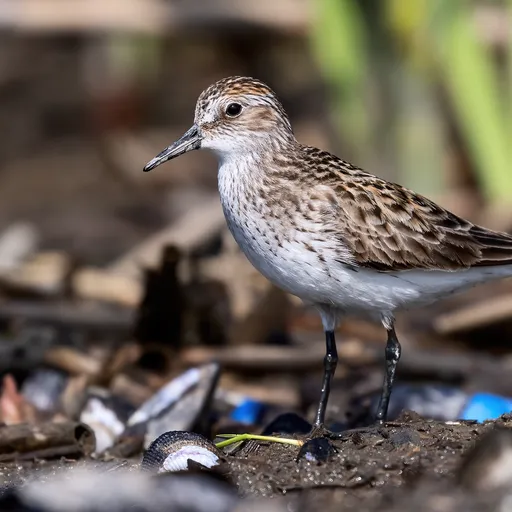
Semipalmated Sandpiper
Calidris pusilla
Near Threatened
Overview
The semipalmated sandpiper is a very small shorebird that belongs to the genus Calidris. It is classified as Near Threatened on the IUCN Red List despite being very numerous. This species is closely related to the western sandpiper and is often grouped with other tiny shorebirds known as 'peeps' or 'stints'.
Identification
- Length ranges from 15–18 cm with a wingspan of 35–37 cm and a weight of approximately 18–51.5 g.
- Plumage features dark grey-brown upperparts and white underparts, with a light grey-brown tinge on the head and neck.
- Possesses black legs and a short, stout, straight dark bill.
- Can be difficult to distinguish from similar tiny shorebirds, particularly the western sandpiper.
Habitat
Breeding occurs in the southern tundra of Canada and Alaska near water, where the species nests on the ground. During winter, these long-distance migrants inhabit coastal South America, with some populations also found in the southern United States and the Caribbean. They are a rare but regular vagrant to western Europe.
Diet
Foraging takes place on mudflats, where food is picked up by sight and feel using the bill. The diet consists mainly of aquatic insects and larvae, spiders, marine worms, snails, and crustaceans. During spring migration, they rely heavily on horseshoe crab eggs, and females consume small mammal bones for extra calcium during egg-laying.
Did you know?
These birds migrate in flocks that can number in the hundreds of thousands, particularly at favoured feeding locations such as the Bay of Fundy and Delaware Bay. Their high numbers are supported by specific key stopover habitats, such as Mary's Point and Johnson's Mills along Shepody Bay.
Sources
- Wikipedia · CC BY-SA 4.0
- Wikidata · CC0 1.0