
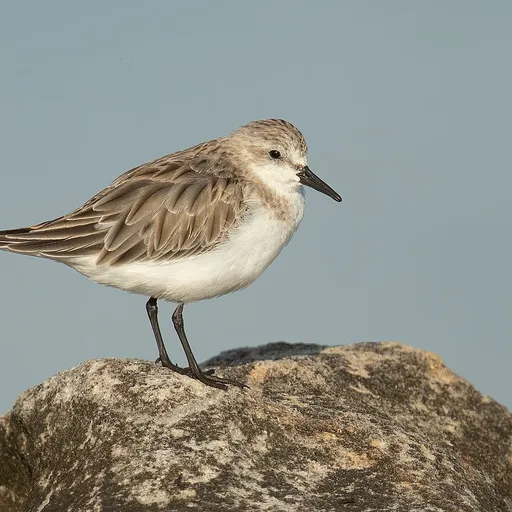
Red-necked Stint
Calidris ruficollis
Near Threatened
Overview
The red-necked stint, Calidris ruficollis, is a small migratory wader that breeds in northeast Russia and spends the non-breeding season along the coastlines of Southeast Asia and Australasia. Listed as Near Threatened by the IUCN, this species is among the smallest of waders and was once considered conspecific with the little stint.
Identification
- Measures 13–17 cm in length, 28–37 cm in wingspan, and weighs 21–51 g, featuring a fine dark bill and dark legs.
- Distinguishable by quicker movements compared to other waders, except for other dark-legged stints.
- Breeding adults display an unstreaked orange breast bordered with dark markings below and a white V on the back.
- Emits a hoarse call described as "stit".
Habitat
Breeding occurs in low-altitude tundra, typically in dry raised areas along the Arctic littoral of eastern Eurasia. During the non-breeding season, the birds inhabit intertidal mudflats and the muddy margins of freshwater lakes in Southeast Asia and Australasia. They are rare vagrants to western Europe and occasionally found in the Americas.
Diet
These birds forage in wet grassland and soft mud, picking up food by sight. Their diet mainly consists of insects and other small invertebrates.
Did you know?
The species is monotypic, meaning no subspecies are recognised, and it was formally described in 1776 by Peter Simon Pallas under the binomial name Trynga ruficollis.
Sources
- Wikipedia · CC BY-SA 4.0
- Wikidata · CC0 1.0