
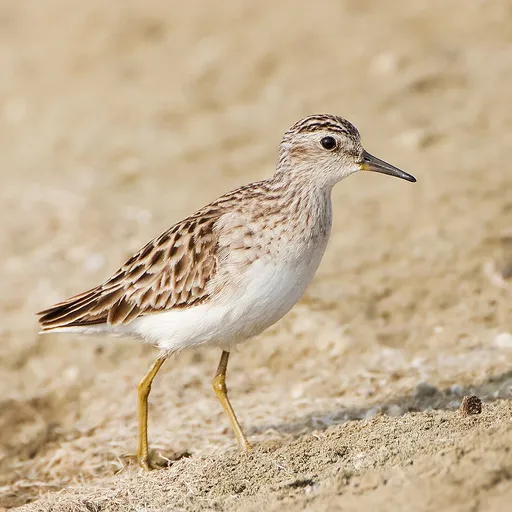
Long-toed Stint
Calidris subminuta
Least Concern
Overview
The long-toed stint is a very small wader that breeds across northern Asia and is strongly migratory. It is considered a bird of Least Concern by the IUCN Red List, with a global population estimated between 10,000 and 100,000 individuals.
Identification
- Measures 13 to 16 cm in length and weighs about 25 g, with a small head and slender neck.
- Has a short, straight, sharp-tipped beak that is dark brown except for a yellow or pale brown base on the lower mandible.
- Features yellow legs with long, slender toes, especially the middle one, giving it a distinctive stance.
- Breeding adults have rich brown upper parts with darker feather centres and white underparts, while non-breeding birds are grey above.
Habitat
Breeds in tundra, taiga, open grassy bogs, and swamps in regions such as Siberia. It winters in a variety of wetland habitats including shallow freshwater or brackish areas, lakes, swamps, floodplains, marshes, lagoons, muddy shores, and sewage ponds. Occurs in western Europe only as a very rare vagrant.
Diet
Forages in wet habitats by probing the ground with its beak and picking up food by sight. It mainly eats small crustaceans, insects, snails, molluscs, amphibians, and seeds.
Did you know?
Its flight call is distinctive enough to distinguish it from other sandpipers, even when visual identification is difficult. Little is known about its breeding habits, but the male performs a display flight.
Sources
- Wikipedia · CC BY-SA 4.0
- Wikidata · CC0 1.0