
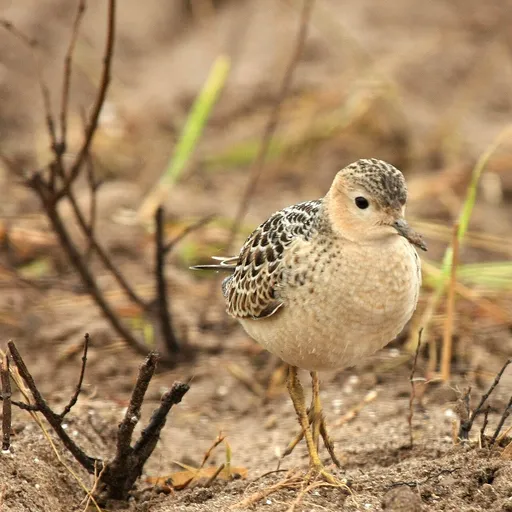
Buff-breasted Sandpiper
Calidris subruficollis
Vulnerable
Overview
The buff-breasted sandpiper is a small shorebird notable for its exceptionally long annual migration from the arctic regions of North America to the pampas of South America. Listed as Vulnerable by the IUCN Red List, this species undertakes a journey that is among the longest recorded for any bird.
Identification
- Brown plumage above with a buff face and underparts.
- Short bill and yellow legs.
- Males are larger than females.
- Juveniles resemble adults but may appear paler on the rear underparts.
Habitat
Breeding populations inhabit the open arctic tundra of North America, nesting on the ground as far north as Canada and Alaska. During the non-breeding season, they primarily occupy short-grass habitats such as airfields or golf courses in South America, particularly Argentina and Uruguay, rather than areas near water.
Diet
These birds forage by picking up food by sight, consuming mainly insects and other invertebrates. They are known to prey on Bombus polaris, a species of bumblebee found within the Arctic Circle, which they may eat themselves or feed to their young.
Did you know?
This species often displays a striking white underside by raising its wings, a behaviour used by males during courtship but also exhibited during migration, sometimes even when no other buff-breasted sandpipers are present. It has also been recorded as a rare vagrant in South Asia and Australia, believed to be wind-blown from the Great Plains Flyway.
Sources
- Wikipedia · CC BY-SA 4.0
- Wikidata · CC0 1.0