
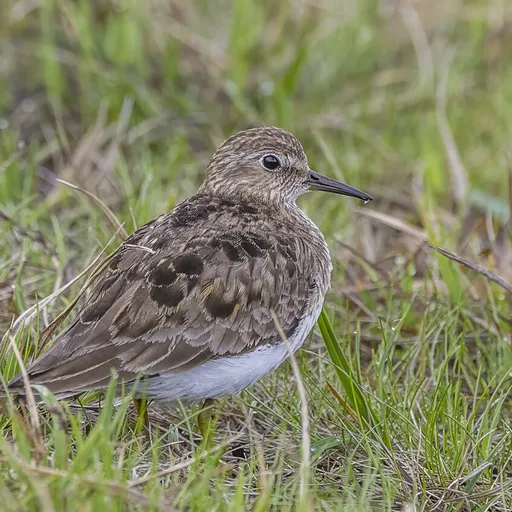
Temminck's Stint
Calidris temminckii
Least Concern
Overview
Temminck's stint (Calidris temminckii) is a very small wader native to the Old World and listed as Least Concern on the IUCN Red List. Its common name and Latin binomial commemorate the Dutch naturalist Coenraad Jacob Temminck. Within its genus, it is most closely related to the long-toed stint.
Identification
- Length of 13.5–15 cm, similar in size to the little stint but with shorter legs and longer wings.
- Legs are dull yellowish or brown, contrasting with the black legs of the little stint, while outer tail feathers are white.
- Breeding adults have plain brown upperparts and a white underparts with a darker breast, often relieved by rufous or blackish mantle feathers.
- Winter plumage is drab, resembling a tiny common sandpiper with dull grey or greenish-grey upperparts.
- Call is a loud trill.
Habitat
This species breeds in bogs and marshes within the taiga of Arctic northern Europe and Asia, ranging from southern Scandinavia and occasionally Scotland east across northern Russia to the Chukotski Peninsula. It is strongly migratory, wintering at freshwater sites in tropical Africa, the Indian subcontinent, and parts of Southeast Asia.
Diet
Foraging occurs in soft mud with some vegetation, where the birds creep steadily along the edges of pools and pick up food by sight. The diet consists mainly of insects and other small invertebrates.
Did you know?
Males and females incubate separate clutches of eggs in different locations; the female typically mates with two males, while the male incubates his first mate's clutch alone while she moves on to the second.
Sources
- Wikipedia · CC BY-SA 4.0
- Wikidata · CC0 1.0