
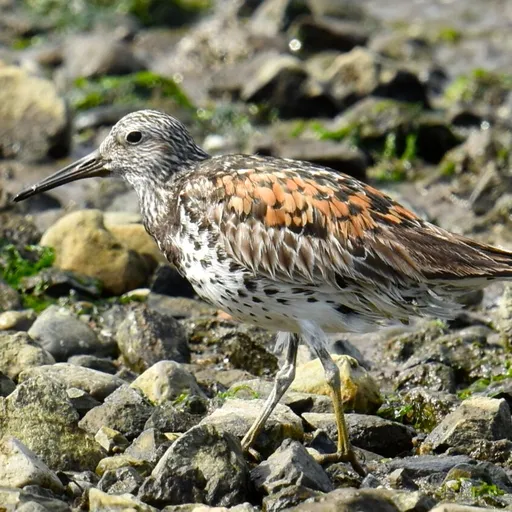
Great Knot
Calidris tenuirostris
Endangered
Overview
The great knot (Calidris tenuirostris) is a medium-sized wader and one of the largest species within the genus Calidris. As a strongly migratory bird, it breeds in the tundra of northeast Siberia and overwinters on the coasts of southern Asia and Australia.
Identification
- Measures 26 to 30 cm in length with a wingspan of 56 to 66 cm, making it larger than the red knot.
- Features short dark legs and a medium-length, thin dark bill.
- Breeding plumage displays mottled greyish upper parts, a distinct band of rufous on the scapular feathers, and heavy black spotting on the face, throat, and breast.
- Winter plumage is uniformly pale grey above.
Habitat
Breeding habitat consists of tundra in northeast Siberia, where the species nests on the ground in a scrape. In winter, it inhabits coasts across southern Asia through to Australia, forming enormous flocks. Rare vagrant records exist in locations such as Great Britain, New Zealand, and parts of North America.
Diet
Forages on mudflats and beaches by probing or picking up food by sight. The diet consists mainly of molluscs and insects.
Did you know?
The species is subject to a complex conservation status in Australia, where it was listed as critically endangered under the federal EPBC Act but a 2023 study argued it no longer met threatened species criteria due to stable or slow-declining populations.
Sources
- Wikipedia · CC BY-SA 4.0
- Wikidata · CC0 1.0