
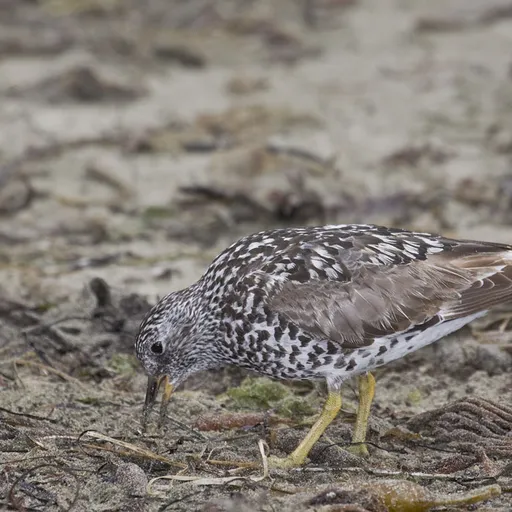
Surfbird
Calidris virgata
Least Concern
Overview
The surfbird (Calidris virgata) is a small, stocky wader in the family Scolopacidae that is currently classified as Least Concern on the IUCN Red List. Although it was once thought to be allied to turnstones, it is now placed in the genus Calidris and is considered a large sandpiper reminiscent of the great knot.
Identification
- Size: Large sandpiper measuring 23 to 26 cm in length and weighing between 133 and 251 g.
- Plumage: Breeding plumage features a rusty crown with black streaks on white heads, necks, breasts, and bellies; non-breeding plumage is mainly grey above and white below with streaking.
- Markings: Distinctive short dark bill, yellow legs, and a black band at the end of the white rump.
- Song: A whistled 'tee tee tee'.
Habitat
Breeding habitat consists of alpine tundra on rocky ridges dominated by scree, rock fields, lichens, dwarf shrubs, and Dryas in Alaska and the western Yukon. During the non-breeding season, it is a rocky shore specialist found on the Pacific coasts of North and South America, from southern Alaska to the Straits of Magellan, staying rarely more than a few meters from the shore.
Diet
On nesting grounds, the diet is dominated by insects, particularly flies and beetles, with some consumption of seeds and snails. Outside the breeding season, it forages on rocky coasts, reefs, and ledges for mollusks and crustaceans, typically within the spray zone from the water's edge to just above the tide line.
Did you know?
The surfbird possesses the longest and narrowest non-breeding distribution of any North American bird, stretching from Kodiak Island in Alaska to the Straits of Magellan at the southern tip of South America.
Sources
- Wikipedia · CC BY-SA 4.0
- Wikidata · CC0 1.0