
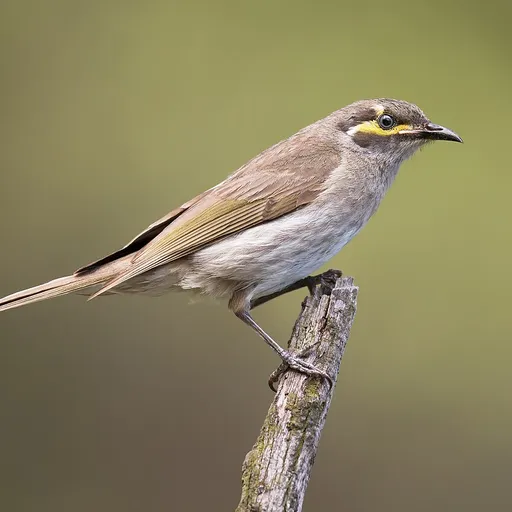
Yellow-faced Honeyeater
Caligavis chrysops
Least Concern
Listen
XC677347 · James Ray · Davis Rd before Pamela Pde (near Marayong), City of Blacktown, New South Wales, Australia · CC BY-SA 4.0
Overview
The yellow-faced honeyeater (Caligavis chrysops) is a small to medium-sized bird in the honeyeater family, Meliphagidae. It is widespread across eastern and southeastern Australia and is considered of least concern for conservation by the IUCN due to its common status.
Identification
- Medium-small greyish-brown bird with distinctive yellow stripes on the sides of the head that broaden below the eye into a white patch on the ear coverts.
- Features a black and slightly down-curved bill with a cream gape, and grey-brown legs and feet.
- Produces a loud, varied song of cheerful 'chick-up' notes starting before dawn, earning it the common name 'quitchup'.
Habitat
Found in open sclerophyll forests ranging from coastal dunes to high-altitude subalpine areas, and riparian woodlands along creeks and rivers. Its range extends along the eastern coastline from Far North Queensland to the Fleurieu Peninsula and Mount Lofty Ranges in South Australia.
Diet
Consumes a mixed diet of nectar, pollen, fruit, seeds, and insects, including flies, spiders, and beetles. It forages arboreally by gleaning from foliage, catching insects in flight, and probing bark crevices, often feeding on flowers of Banksia and Grevillea species.
Did you know?
The species uses a magnetic inclination compass to navigate during migration, distinguishing between the direction of the equator and the South Pole rather than relying on magnetic polarity. One bird was recorded travelling between its nest and a koala 36 metres away to pluck long hair near the animal's ears for nesting material.
Sources
- Wikipedia · CC BY-SA 4.0
- Wikidata · CC0 1.0