
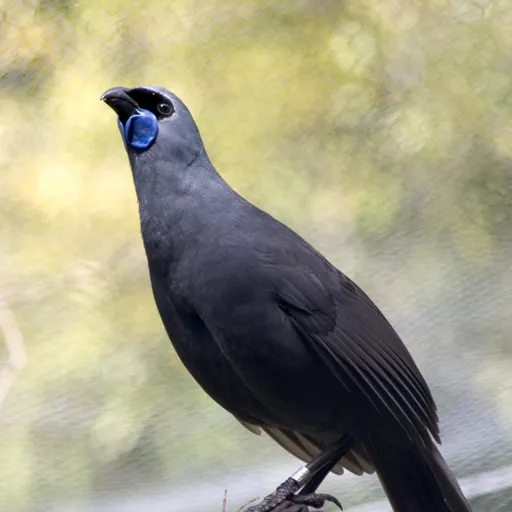
North Island Kokako
Callaeas wilsoni
Least Concern
Overview
The North Island kōkako (Callaeas wilsoni) is a medium-sized forest bird endemic to the North Island of New Zealand. It is a non-flying adept climber that survives in several native forests and offshore sanctuaries, though its population relies heavily on ongoing conservation management. The species is currently listed as Least Concern by the IUCN, although authorities remain cautious regarding its long-term vulnerability.
Identification
- Slender, medium-sized bird with silky, slate-grey to smoky blue plumage and slightly darker wings and tail.
- Distinctive black facial mask covering the eyes and extending to the base of the bill.
- Vivid blue, fleshy wattles hang from the lower mandible, which serve thermoregulation and social signalling roles.
- Emits a slow, rich 'ko-ka-ko-o-o-o' vocalisation that trails off at the end.
Habitat
This species inhabits native forests on the North Island of New Zealand and its offshore islands. It is found in locations such as Pureora Forest Park, Whirinaki Te Pua-a-Tāne Conservation Park, and the Hunua Ranges. It is also present on predator-free offshore sanctuaries like Tiritiri Matangi and Kapiti Island, where regenerating forest allows for easier observation.
Diet
The kōkako follows an omnivorous diet consisting of fruits, leaves, and invertebrates. It uses its sturdy, black bill to process this varied food supply while navigating the forest canopy with its powerful legs.
Did you know?
The blue wattles of the kōkako function as natural thermostats, increasing blood flow to dissipate heat on hot days and decreasing it to conserve warmth when the temperature drops.
Sources
- Wikipedia · CC BY-SA 4.0
- Wikidata · CC0 1.0