
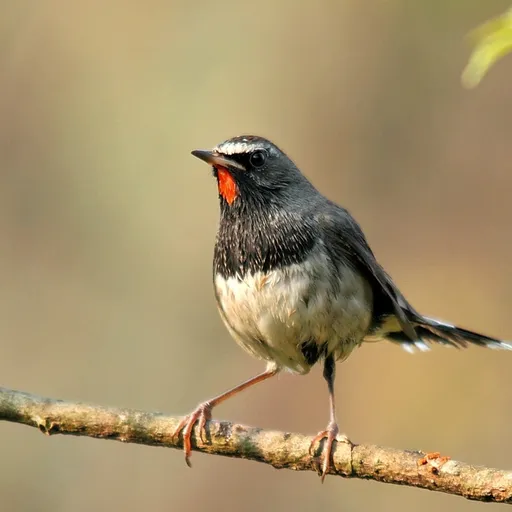
Himalayan Rubythroat
Calliope pectoralis
Least Concern
Overview
The Himalayan rubythroat (Calliope pectoralis) is a passerine bird in the family Muscicapidae, closely related to the Siberian rubythroat. It was previously considered part of the 'white-tailed rubythroat' complex but is now recognised as a distinct species.
Identification
- Males are slaty brown above with a white forehead, while the centre of the chin and throat is scarlet and the sides are black with grey fringes.
- The tail is blackish with distinctive white bases and tips, distinguishing it from the similar Siberian rubythroat.
- Females are dull brownish grey above with smoky underparts, and may possess a short whitish moustachial stripe in eastern populations.
- The male's song consists of a series of squeaky notes sung from exposed perches during the day, while the alarm call is a sharp yapping 'skyap'.
Habitat
Found along the Tien Shan and Himalayan ranges from Afghanistan to Myanmar, this species inhabits open woodland and scrub. It migrates to higher altitudes in summer and lower elevations in winter, sometimes appearing in summer on lower plains.
Diet
This species feeds mainly on small insects, including beetles and ants. During the breeding season, parents forage close to the nest and feed young primarily with hairy caterpillars.
Did you know?
The summer song of the male inspired the 1995 musical composition Summoning Dawn by Scottish composer Magnus Robb, who was prompted to write it after playing the bird's calls at a fourth of their normal speed.
Sources
- Wikipedia · CC BY-SA 4.0
- Wikidata · CC0 1.0